Check out Stephen C. Meyer’s new book, Darwin’s Doubt. It is a good challenge to the denominate evolutionary presuppositions out there. Here is his brief infographic to get your mind churning.
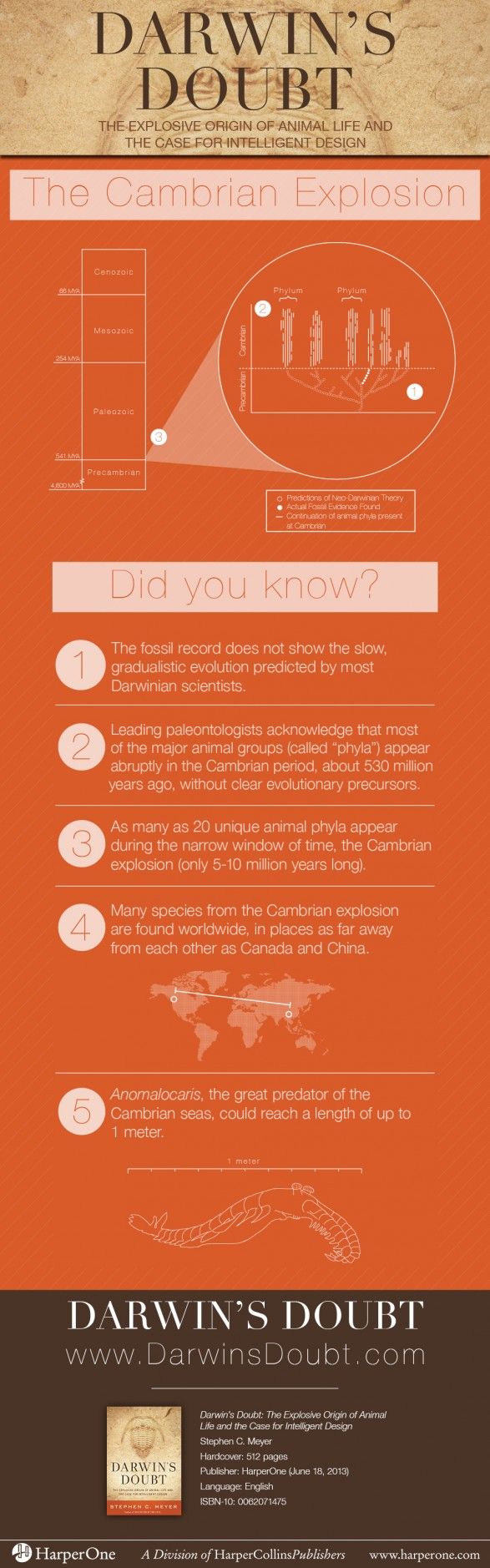
Check out Stephen C. Meyer’s new book, Darwin’s Doubt. It is a good challenge to the denominate evolutionary presuppositions out there. Here is his brief infographic to get your mind churning.

Tonight Eric Metaxas will be leading a free, live, webcast discussion on his latest book, Miracles.
To reserve your admission to this online event click: Miracles Live Stream.

Metaxes is most well known for two biographies, Amazing Grace: William Wilberforce and the Heroic Campaign to End Slavery and Bonhoeffer: Pastor, Martyr, Prophet, Spy. His latest book, and feature of this webcast, is Miracles: What they are, why they happen, and how they can change your life. Here is a description:
Miracles:
What they are, why they happen, and how they can change your life
An inspiring and eye-opening exploration of the phenomenon of miracles from the New York Times #1 bestselling author of Bonhoeffer.
What are miracles, and why do so many believe in them? What do they tell us about ourselves? And what do we do with experiences that we cannot explain?
In Miracles, Eric Metaxas offers compelling — sometimes electrifying — evidence that there’s something real to be reckoned with, whatever one has thought of the topic before. Miracles is also a timely, thoughtful, and civil answer to the books of the “New Atheists” — Richard Dawkins, Christopher Hitchens, and Sam Harris — who have passionately asserted not just the impossibility of miracles and the supernatural, but the outright harmfulness of belief in them.
Metaxas — whom ABC News has called a “witty ambassador for faith” — provides the measured and wide-ranging treatment the subject deserves, from serious discussion of the compatibility between faith and science, to astonishing, but well-documented stories of actual miracles from people he knows.
A more personal, anecdotal, and updated version of C. S. Lewis’s 1947 book on the subject, Miracles is a powerfully winsome challenge that miracles are not only possible, but are far more widespread than most of us ever might have imagined.

Romans 8 is a lighthouse of encouragement when the fog of life rolls in confining our view to immediate circumstances. In it we find perspective. In it we find Hope. Despite the pain and heartache we may encounter on our journey, Romans 8 reminds of us of truth.
Sometimes we need to be reminded of what we already know.
Sometimes we need to rehearse to ourselves the truths we already claim.
Sometimes we need to stop focusing on how we feel, and focus on what we know.
Romans 8 is a proclamation of the one and only Solid Ground. All other ground is sinking sand.
“My Hope is Built on Nothing Less”
by Edward Mote, 1797-1874
1. My hope is built on nothing less
Than Jesus’ blood and righteousness;
I dare not trust the sweetest frame,
But wholly lean on Jesus’ name.
On Christ, the solid Rock, I stand;
All other ground is sinking sand.
2. When darkness veils His lovely face,
I rest on His unchanging grace;
In every high and stormy gale
My anchor holds within the veil.
On Christ, the solid Rock, I stand;
All other ground is sinking sand.
3. His oath, His covenant, and blood
Support me in the whelming flood;
When every earthly prop gives way,
He then is all my Hope and Stay.
On Christ, the solid Rock, I stand;
All other ground is sinking sand.
4. When He shall come with trumpet sound,
Oh, may I then in Him be found,
Clothed in His righteousness alone,
Faultless to stand before the throne!
On Christ, the solid Rock, I stand;
All other ground is sinking sand.

 When we pray, the Father aligns us to His heart. We acknowledge our dependence on Him. Prayer is communion and communication. Through the Bible we breathe in God’s words, through prayer we breathe out our response.
Prayer is essential to the Christian life.
Our church is taking a class though Tim Keller’s recent book, Prayer: Experiencing Awe and Intimacy with God. In it we find five helpful steps. At times all we can do simply cry out “Abba” and we must depend on the Spirit to intercede on our behalf. But at other times, we can be more mindful of our prayer life, and these steps can help bring order to this essential area of growth. Why would we not maximize effectiveness and fruit of our prayer time if intentionality is all that is required? Let these steps be a guide to a vibrant relationship with God.
1) Evocation. To evoke means “to bring to mind,” though it also can includeinvocation, calling on God. Keller says that there is almost, “universal agreement that prayer should be started by ‘thinking over who it is that you will be addressing, what he has done to give you access to himself, and how you stand related to him …” Think before you pray.
2) Meditation. To respond to God in prayer, we must listen to his Word. This means taking some time to meditate on some portion of the Bible as a bridge to prayer. Meditation is a form of reflection and self-communion. Take a verse or two, or an entire section, and meditate on it as a way of fueling your heart to prepare you to pray.
3) Word prayer. Keller received this insipiration from Martin Luther. And this is a step that is often overlooked. After meditating on Scripture, Luther takes time to “pray the text” before moving on to more free-form prayer. Luther advises that we take the Lord’s Prayer and paraphrase each petition in his or her own words, filling it out with the concerns on his or her heart that day. Keller advises that we do this at least once a week.
4) Free prayer. Free prayer, as Keller explains, means simply to pour out your heart before the Lord in prayer. This is where we bring on all the supplications, petitions, prayer-lists, and anything on our heart that we want or need. This is the kind of prayer that we’re probably most familiar with. Helpful — indeed, God is our Father and we are his children and he loves it when we ask him for things — but J.I. Packer would warn us that this kind of prayer is only life-changing if it is not merely running down a “grocery-list,” but instead lifts each cause to God with theological reasoning and self-examination.
5) Contemplation. Here, Keller points us to Jonathan Edwards who points us to the Lord: “Edwards described contemplation as times when we not only know God is holy, but when we sense — ‘”see’” and ‘”taste’” — that he is so in our hearts. Luther would say that this is like getting “lost” in some aspect of God’s truth or character. Either way, prayer is always enhanced when we end with praise and contemplation.
“Don’t be intimidated by these plans,” Keller adds at the end. He finishes with saying, “Follow the steps … without feeling the need to do all the specific proposals or answer all the questions within each part. Prayer will grow and draw you in.”
Yesterday I had the privilege to preach at our church on this very important question.
“How can I know the Bible is true?”
It is a question of foundations, how do we really know. In universities and seminaries this is called epistemology, but I never dropped that word bomb in my sermon. For us, its just real life. How do we know the bible is true, as well anything at all? Can we really have certainty on anything!
My answer is ultimately, YES, we can!
You can listen to my sermon for the full audio on this topic.
You can also keep reading for the main points I’m trying to make.

There are many ways to tackle this question.
I outline the 1) Personal Experience Standard, 2) Just have Faith Approach, 3) The Bible says it Method, 4) Textual Uniqueness, 5) External Evidences, 6) Internal Divine Insights, – all of which have strengths and weaknesses.
The most powerful explanation I have found for certitude on the Truth of Scripture is in its exclusive ability to provide a foundation for Reason and Morality. The Bible alone explains why we can trust our own understanding and our sense of right and wrong.
Only the Bible presents an accurate picture of reality. Carl Henry nails it as he astutely writes,
“But the nature of truth is such that the Christian revelation is formally intelligible to all men; it convincingly overlaps ineradicable elements of every man’s experience, and offers a more consistent, more comprehensive, and more satisfying explanation to the meaning and worth of life than do other views.” (GRA I, 238)
This worldview is one in which logic and reason are rooted in the Image of God. Genesis 1:27 says in His image he created us, male and female.
The bible shows that God Himself is the standard to judge all things. Col. 2:3 “in whom are hidden all the treasures of wisdom and knowledge.” Logic has its root in the person of God. The Bible reveals this to us.
The way in which God’s mind works is purely logical; Titus 1:2.- “for God cannot lie”, also in 1 Cor. 14:33 “God is not a God of confusion.”
Without the Bible we would not have a firm foundation from which we could know anything! If we dismiss the bible, how do we account for the logic we depend on for every thought or discussion?
We count on the laws of logic to never change, why is that?
Because God never changes. Micah 3:6 says, “I the Lord do not change.” James 1:17, “Every good and perfect gift is from above, coming down from the Father of the heavenly lights, who does not change like shifting shadows.” Hebrews 13:8 “Jesus Christ is the same yesterday and today and forever.”
We are rational beings having rational thoughts right now because God is who he says he is, and we know this through the Bible.
Morality is equally rooted in the person of God as revealed in the bible.
The bible has revealed a God who is Good and a world that is fallen. Every person and every society of all time has had a sense of right and wrong. Where did this come from? Why do we even seek for truth rather than a lie?
Because we were created in the image of God.
The bible does not ignore the evil in our world or make excuses, but explains it. We see ourselves for who we really are as we read its pages. We find the answer to the problem of evil through the redemptive plan of God to rescue us from that evil. All of this is revealed in the bible. It accurately describes our reality.
What anchors our understanding of Good?
Psalm 100:5 “For the Lord is good and his love endures forever”. Psalm 136:1 “give thanks to God for he is Good”. In John 10 Jesus is called the “Good Shepard”. And yet we know that we are not Good, which is affirmed in the bible. Jeremiah 17:9 “the heart of man is deceitful and desperately wicked”. Mark 7 talks about the sinfulness of man does not comes from just his mouth, but from his heart. Romans 3:23 rightly says, “all have sinned and fallen short of the glory of God.”
The understanding of right and wrong is not a herd mentality or social construct, but it is written on our hearts by our Creator.
Apart from the bible we have no foundation for the reality that we all live in and accept as truth every moment of every day.
Why is there reason and rationality? Why is there right and wrong? God has revealed why in the bible.
How do we know the bible is true?
If it is not true, we have no foundation to make sense of reality as we know it. Without presuming the truth of the bible, we cannot prove anything else.
“I believe in Christianity as I believe that the sun has risen: not only because I see it, but because by it I see everything else.” -CS Lewis
Southern Seminary has made some of it’s best content available for free download.
Go to the SBTS Press for access to these seven free pdf e-books, or just click the links provided here.
________________________________________________________________

Edited by R. Albert Mohler Jr.
Christians and homosexuality is a hotly debated topic in today’s evangelical world, and Southern Seminary continues that conversation in this publication. Matthew Vines’s new book, God and the Gay Christian: The Biblical Case in Support of Same-Sex Relationships, argues that homosexual orientation and committed same-sex relationships are consistent with a “high view” of the Bible and evangelical Christianity. Southern Seminary president R. Albert Mohler Jr. and four other seminary faculty members refute this claim in the new SBTS Press e-book, God and the Gay Christian? A Response to Matthew Vines.
Each chapter refutes Vines’s claims from six specific Scriptural references to homosexuality. Mohler’s chapter provides an overview critique of Vines’s book. James M. Hamilton Jr., professor of biblical theology, addresses the Old Testament claims; Denny Burk, professor of biblical studies, addresses New Testament claims; Owen Strachan, assistant professor of Christian theology looks at the church history assertions; and Heath Lambert, assistant professor of biblical counseling, answers whether there is such a thing as a “gay Christian.”
Download the free e-book or PDF

by R. Albert Mohler Jr., Donald S. Whitney and Daniel S. Dumas
This is a different sort of book. Or workbook. Or journal. Whatever it is, this resource from The Southern Baptist Theological Seminary is meant to help you discern whether or not God has called you to ministry. And it’s meant for you to use and devour. You’ll notice pages with blank space; those pages are for you to respond to questions, react to the quotations and reflect on the Scripture references you’ll find throughout. So, open your Bible, get out your pen and discover whether God has called you to this most noble and weighty task. Watch the promotional video by Dan Dumas here.
Order Now:

by Dan DeWitt
A Guide to Evangelism, edited by Dan DeWitt, will equip Christians and churches with the tools they need for more faithful evangelism. With chapters focusing on the role that a church’s preaching and polity can play in the task of evangelism, as well as chapters with practical advice for Christians engaging different groups, such as Muslims, skeptics and nominal Christians, this book will help Christians fulfill their role inspreading the gospel so that grace extends to more people to the glory of God.
Order Now:

Order Now:
 Dan Dumas, Ed.

by Russell D. Moore, Ed.
The current adoption culture among Christians is a necessary and welcomed movement. Many people, however, don’t understand how the Bible directs and informs adoption. A Guide to Adoption and Orphan Care, edited by Russell D. Moore, seeks to help adoptive parents and churches better think about and practice adoption.
Order Now:
 By Randy Stinson & Dan Dumas
Imagine the best news ever was just announced; a cure for cancer was found, peace is reached in the Middle East, world hunger was solved. There would be dancing in the streets! Imagine a joy that was indestructible, not connected to a fleeting moment.
This is Christmas!
A clip addressing family holiday preperations from John Piper focuses on the message of the Angel who appeared to the shepherds. “Good News and Great Joy”. This embodies the message of Christmas. @DesiringGod tweeted Piper in powerful statement, “If being Jesus-focused is a killjoy for Christmas, you don’t know him.”
The truth about Christmas is that it is the greatest news and greatest joy that has ever come to humanity! It cannot be overstated. Any substitute for this message is a dim shadow of the truth in this holiday.
Just as I am trying with my family, I challenge your family to focus on Christmas in its truest sense this year.
 adamlickey.com