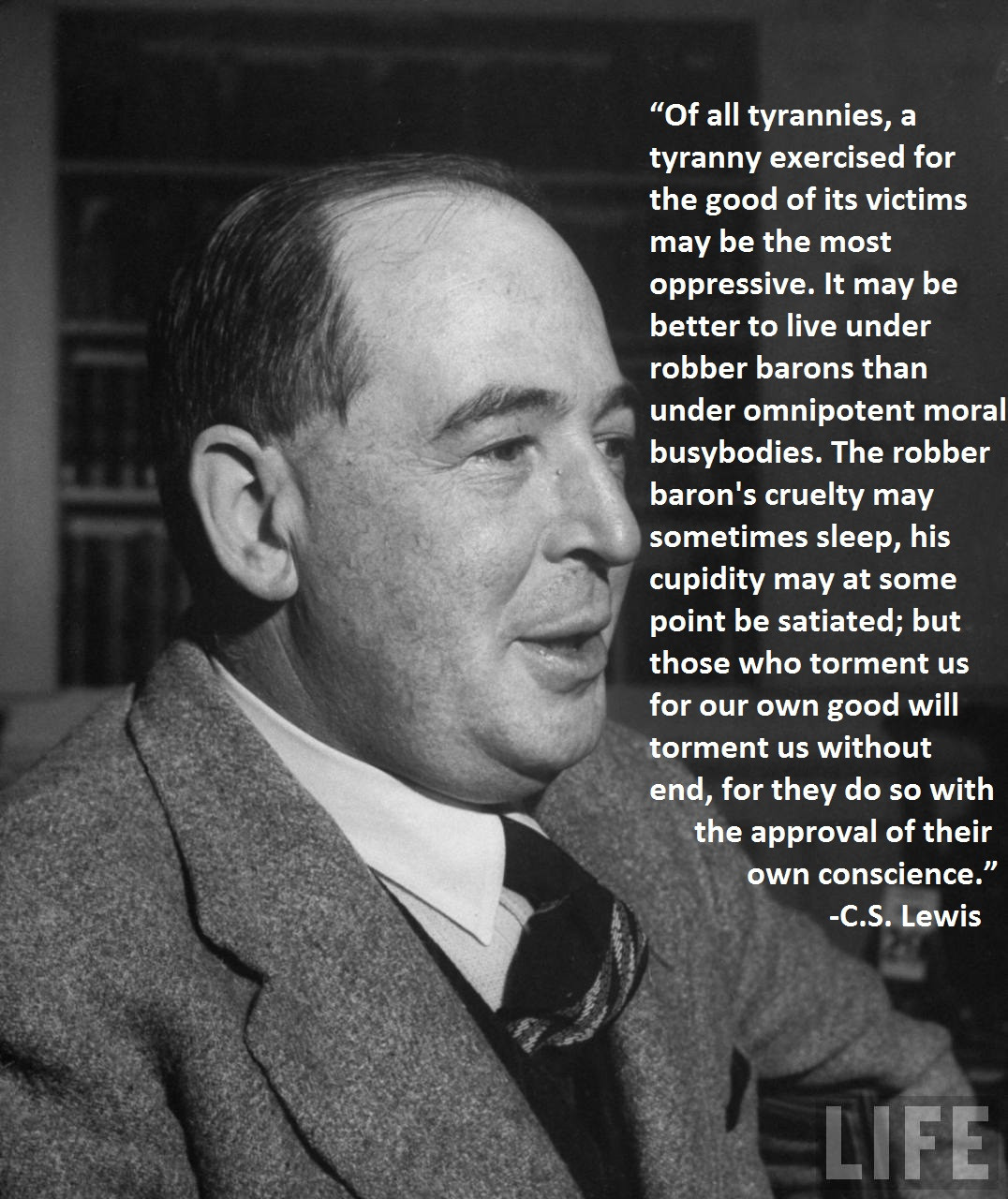
Saturdays with C.S. Lewis: Tyranny


The great thing to remember is that, though our feelings come and go, His love for us does not. It is not wearied by our sins, or our indifference; and, therefore, it is quite relentless in its determination that we shall be cured of those sins, at whatever cost to us, at whatever cost to Him. – C.S. lewis, Mere Christianity 
Well, today is my birthday. This becomes less of a big deal, and more of a reminder that my body is breaking down. But here is a quote from C.S. Lewis that is plastered all over the internet that seems appropriate. (to be honest I am highly suspicious of this quote. Though it is attributed to him, no one ever sites a work and it seems a little to cliche for his style.) All the same, to set a goal and pursue a dream is never out of date. 🙂


 My argument against God was that the universe seemed so cruel and unjust. But how had I got this idea of just and unjust? A man does not call a line crooked unless he has some idea of a straight line. What was I comparing this universe with when I called it unjust? If the whole show was bad and senseless from A to Z, so to speak, why did I, who was supposed to be part of the show, find myself in such violent reaction against it? A man feels wet when he falls into water, because man is not a water animal: a fish would not feel wet. Of course I could have given up my idea of justice by saying it was nothing but a private idea of my own. But if I did that, then my argument against God collapsed too—for the argument depended on saying that the world was really unjust, not simply that it did not happen to please my fancies. Thus in the very act of trying to prove that God did not exist—in other words, that the whole of reality was senseless—I found I was forced to assume that one part of reality—namely my idea of justice—was full of sense. Consequently, atheism turns out to be too simple. If the whole universe has no meaning, we should never have found out that it has no meaning: just as, if there were no light in the universe and therefore no creatures with eyes, we should never know it was dark. Dark would be a word without meaning.
Quotes from Mere Christianity, Part 15
C.S. Lewis, Mere Christianity (1952; Harper Collins: 2001) 38-39.
 CAN’T YOU LEAD A GOOD LIFE WITHOUT BELIEVING IN CHRISTIANITY? This is the question on which I have been asked to write, and straight away, before I begin trying to answer it, I have a comment to make. The question sounds as if it were asked by a person who said to himself, ‘I don’t care whether Christianity is in fact true or not. I’m not interested in finding out whether the real universe is more like what the Christians say than what the Materialists say. All I’m interested in is leading a good life. I’m going to choose beliefs not because I think them true but because I find them helpful.’ Now frankly, I find it hard to sympathise with this state of mind. One of the things that distinguishes man from the other animals is that he wants to know things, wants to find out what reality is like, simply for the sake of knowing. When that desire is completely quenched in anyone, I think he has become something less than human. As a matter of fact, I don’t believe any of you have really lost that desire. More probably, foolish preachers, by always telling you how much Christianity will help you and how good it is for society, have actually led you to forget that Christianity is not a patent medicine. Christianity claims to give an account of facts —to tell you what the real universe is like. Its account of the universe may be true, or it may not, and once the question is really before you, then your natural inquisitiveness must make you want to know the answer. If Christianity is untrue, then no honest man will want to believe it, however helpful it might be: if it is true, every honest man will want to believe it, even if it gives him no help at all.
C.S. Lewis, “Man or Rabbit?” published as a pamphlet for the Student Christian Movement in Schools (probably 1946) and God in the Dock (Eerdmans: 1970) 108-109.
 adamlickey.com