Social Media Boundaries for Student Ministry Workers

social mediaLets face it, social media is part of life. It is a two edged sword if you are not careful how it is handled. When working with teenagers we have an added responsibility to model how to live and act, even in the online forum. I ran across this helpful article by Phil Bell of Youthworktalk.com and forwarded it on to my small group leaders. Here are his wise suggestions for some boundaries regarding the powerful tool of social media.

___________________________________________________________________________________________

Here are 5 social media boundaries for you as you go about your youth ministry:

1) Accept that leaders live in ‘glass house.’ This is hard to accept, but when you are in ministry and you are using social media, it automatically means that you are under the spotlight. Leaders, parents, and students are looking up to you and will often follow you for inspiration, guidance, and hope. On the other hand, others will follow you to get an inside track to see whether you fit their mold of an acceptable youth worker.

Like it or not, the reality is that a leader is always watched closely. What are others seeing?

2) Wait to be Friended or Followed: If you don’t know a student well, wait for them to friend or follow you. I know this might seem a little extreme, but unless I know a student quite well, I will wait for them to friend me. If there is a student in your ministry who is new and getting plugged in, it might be worth waiting for them to friend you. Waiting for a student to ‘friend’ you simply avoids any weirdness and ensures they are happy for you to get an inside track to their life.

3) Avoid Private Conversations: Avoid private messaging students. Try to keep messages public and for all to see. If a student wants to talk to you about an issue or a problem, try to do it face to face in full site of others. It’s also essential to communicate with parents that you are talking to their student. I know this might seem a little over the top, but here are two good reasons why contacting parents is a good idea:

  • It opens the door for a relationship to partner with parents.
  • It avoids parents wondering what your intentions are. In this day and age, parents are protective when other adults contact their kids, and rightly so. Honor parents by touching base and letting them know who you are.

4) Consider carefully what you post: Here are three things that can get you in trouble.

  • Questionable pictures: In certain social media platforms such as Facebook, you can create a setting that gives you the option to ‘allow’ pictures you are tagged in. Ensure that the pictures of you will always allow others to see you in a positive light.
  • Complaints: Complaining about others simply does not look good. It shows weakness that we can’t talk to the person directly as well as modeling a poor method of dealing with conflict.
  • Controversial Issues: For me I don’t post  anything that could divide people in my church. Political statements, local controversies, and attacks on political leaders should be avoided.

In what you post, would others describe you as a  divisive and opinionated person, or a inspirational leader? 

5) Leverage social media to inspire and uplift:  This should be a given, but many of us have discounted the great value of regularly posting to inspire others. As I said at the beginning of this post. People are looking for hope and direction. Consider what influence you can have by using social media effectively?


Abortion Statistics: 40 Years in the Making

40 years ago today, on January 22, 1973, Roe v. Wade quietly changed the landscape of our nation. A 7-2 decision by the Supreme Court has resulted in an estimated 54,559,615 million abortions based on findings from the Guttmacher Institute (a pro-choice research facility). The National Right to Life Committee (the oldest and largest pro-life organization) produced the United States Data and Trends, which sights the above statistic and much more.

Here is an infograhic that helps visualize some of the staggering numbers.

abortion-statistics-politics-infographic2

5 Reasons I Write My Own D-Now Curriculum

dnow
The Band has been rockin’, the speaker has been bringing the Word. Disciple-Now is in full swing this weekend for my ministry. The students just finished up a video scavenger hunt and have gone to a few hours of free time before our next session. In this moment to breathe I have decided to type up a quick blog on some of my methods. It was on my mind last night when I couldn’t sleep because I was thinking of all the details for the next day. If you work with teenagers, I hope this encourages you to take your next event to the next level.

Here are 5 reasons why I write my own material for event weekends like Disciple Now.

  1. It’s Free– When paying for a band and a speaker, hotel rooms, small group leaders, travel expenses, and the list goes on, here is an area I can save money. If you preach every Wednesday anyway, this is not very different study-wise, other than I just give the material to someone else to teach. By writing my own material I can maximize the funds toward keeping the cost low for the students. This year I charged $10. Bam. Success. There are lots of students who don’t participate in camps and retreats because it costs 100s of dollars. This is an event I want any and every teen to be able to come to. A little more work on my end helps keep it that way.
  2. Be Theologically Rich– Even though it is free, that doesn’t mean when you write your own material it will be lame! I make sure we tackle deep subjects and dive into the theological deep end! When you purchase a pre-packaged curriculum you do not know the theological leanings of the writer or the depth to which they will challenge your students. I want my students to have the best, so why would I leave that up to an unknown author? This weekend we are looking at Ephesians 3 – a theological treasure trove! Oh yeah!
  3. The Exegetical Approach–  On the heels of #2, I really believe every verse in scripture is important for believers. If that is true I want to instill that into my teenagers. When we take a whole weekend to unpack a single chapter of the bible, that is one message that is communicated. Also when you systematically approach a text, it makes it easier to see the bigger picture the author intended to communicate. I believe this also provides cohesiveness to the weekend. Each time we gather the students know where to turn in their bibles. I have not found any national chain producing exegetical material for events like this, possibly with the exception of Global Youth Ministry, but then again, refer to point #1.
  4. I know my group– When you write your own material you can tailor it for your specific group. While God can use anything and anyone to speak through, I doubt that same d-now material being used by 43 other churches this weekend can intentionally speak to the subtleties of a specific group better than a prayerful pastor who spends every week with them. So why not use a weekend to address what you want to see happen! It helps when another voice comes in and says the same things you have been saying all along.
  5. Graphics don’t have to be intimidating– “I cant make great looking flyers and promo material!?!” For real, don’t be scared, you can. Here are two things that make life super easy when it comes to promoting your event. Cool Fonts and Stock Photos. Combining these make great stuff.  My d-now was themed “The Mystery”, below is a cool stock photo and a cool font to title it. Bam, easy promotion. Sites I uses for photos are istockphoto.com and Bigstockphoto.com. Make an account and spend a few buck on a high res picture with no copy right issues for your next event. Then go to dafont.com or just google “free fonts” and get some fonts that really add depth to your flyer.  It’s not that hard and for a couple bucks you can have a professional looking flyer/promo that corresponds to your personalized material.

I hope these thoughts help as you plan your next d-now or retreat weekend! Pray for me as we wrap up ours! May God be glorified by your efforts!

-Adam

mystery image

5 Good Responses to Giglio’s Presidential Diss

discriminationHere are some well thought out implications of the heavy weight decision by the Presidential Inauguration Committee to shun Louie Giglio because of his religious convictions.

Ed Stetzer – The Louie Giglio Moment: Are Evangelicals No Longer Welcome in the Public Square?

Al Mohler – The Giglio Imbroglio: The Public Inauguration of a New Moral McCarthyism.

Joe Carter – Pastor Disinvited From Giving Inaugural Prayer Because of Sermon on Homosexuality.

Russell Moore – Louie Giglio and the New State Church

Nick Rynerson – The Unfortunate Shaming of Louie Giglio by the Gay Rights Community


Louie Giglio Withdraws His Acceptance to Pray at the Presidential Inauguration

giglioPastor Louis Giglio has removed his prior acceptance of the offer of giving the benediction at President Obama’s second inauguration.

Check out his letter of resignation. It has the typo of 2014, not 2013, but clearly states that he and his ministry don’t want to wade into an embattled issue that is not beneficial to the goals of their ministry.

January 10, 2014 [sic]

I am honored to be invited by the President to give the benediction at the upcoming inaugural on January 21. Though the President and I do not agree on every issue, we have fashioned a friendship around common goals and ideals, most notably, ending slavery in all its forms.

Due to a message of mine that has surfaced from 15-20 years ago, it is likely that my participation, and the prayer I would offer, will be dwarfed by those seeking to make their agenda the focal point of the inauguration. Clearly, speaking on this issue has not been in the range of my priorities in the past fifteen years. Instead, my aim has been to call people to ultimate significance as we make much of Jesus Christ.

Neither I, nor our team, feel it best serves the core message and goals we are seeking to accomplish to be in a fight on an issue not of our choosing, thus I respectfully withdraw my acceptance of the President’s invitation. I will continue to pray regularly for the President, and urge the nation to do so. I will most certainly pray for him on Inauguration Day.

Our nation is deeply divided and hurting, and more than ever need God’s grace and mercy in our time of need.

The media has breathed a sigh of bitter relief it seems. The Washington Post published this blatantly one-sided and opinionated article titled, Louie Giglio out from Inaugural: Good. Before it was official, Instinct Magazine published an article titled, Worse Than Rick Warren? President Obama Gives Inaugural Benediction To Another Anti-Gay Pastor, that quotes from Giglio’s sermon complete with sub-headings to help guide the rage of the Gay community. Apparently it had its desired effect.

Wow. Talk about stirring up a hornet’s nest.

It is to bad that Giglio felt so much pressure that he needed to withdraw from such an honor. I think it is interesting that in his resignation letter we find no hint of backing down on his former stance. He is exactly right in how he calls the nation to prayer for our leaders, even if a segment of our nation has clamored against his selection. I believe Giglio is sincere in his words and should be commended on how he has handled this unfortunate development.

Keep up the good work Louie, keep making much of Jesus Christ through every platform available to you.


TIME Sounds the Alarm: The Pro-Life Cause is Winning

TIME Sounds the Alarm: The Pro-Life Cause is Winning

by Trevin Wax

On the cover of TIME this week is this headline:  “40 Years Ago, Abortion-Rights Advocates Won an Epic Victory with Roe v. Wade. They’ve Been Losing Ever Since.”

The story – “What Choice?” – is written by Kate Pickert. The main point of the article is that Roe v. Wade hurt the pro-choice cause by delivering the movement’s main goal and by energizing a generation of pro-life activism.

Not surprisingly, the story is biased against the pro-life cause. Though the issue of “personhood” and “life” is alluded to (see below), Pickert never explores the reasons for a surge in pro-life activity. Had she sought to explain the pro-life perspective, she would have shown how this debate is really a showdown between reproductive rights and human rights, and which rights are foundational to freedom.

Still, I commend Pickert for using the terminology of “pro-life” and “pro-choice” throughout the article. (She doesn’t use these terms consistently, but it’s nice to see the terms both sides prefer utilized in a journalistic piece.)

Summary of the Article

The story gives us an inside-glimpse of an abortion clinic and its director, Tammi Kromenaker. Pickert shows how it is increasingly difficult to obtain an abortion in certain areas of the country, due primarily to statewide legislation regulating abortion:

In 2011, 92 abortion-regulating provisions–a record number–passed in 24 states after Republicans gained new and larger majorities in 2010 in many legislatures across the country. These laws make it harder every year to exercise a right heralded as a crowning achievement of the 20th century women’s movement.

Surveying the landscape of pro-life legislation, Pickert paints a stark picture for pro-choice advocates:

While the right to have an abortion is federal law, exactly who can access the service and under what circumstances is the purview of states. And at the state level, abortion-rights activists are unequivocally losing.

Why is this the case? Pickert pulls no punches. Pro-choice advocates are losing the debate:

Part of the reason is that the public is siding more and more with their opponents. Even though three-quarters of Americans believe abortion should be legal under some or all circumstances, just 41% identified themselves as pro-choice in a Gallup survey conducted in May 2012…

If abortion-rights activists don’t come together to adapt to shifting public opinion on the issue of reproductive rights, abortion access in America will almost certainly continue to erode.

Even after the reelection of President Obama and the defeat of a pro-life candidate like Richard Mourdock (who got into hot water with their controversial comments on rape and pregnancy), Pickert points out that the winning Democrat is also pro-life.

Throughout the article, Pickert laments the shrinking of abortion rights and explains the reduction by pointing to the relegation of abortion to specialized clinics, new government regulations on the practice, and generational differences in the pro-choice camp. Though Pickert describes an abortive procedure in clinical, unemotional terms, she deserves credit for taking us behind the closed doors of a clinic to see what happens:

On this Wednesday it’s Dr. Kathryn Eggleston, who informs the woman that she’s reviewed her chart and asks, “Are you confident in your decision to have an abortion today?” If the woman says yes, the abortion begins; the whirring of the vacuum aspirator used to extract the fetus can be heard in the hallway. Within 15 minutes, Eggleston emerges from the room and enters another where the removed contents are examined and photographed for the medical record.

To be more specific, the fetus (baby) is extracted (by dismemberment), and the removed contents (body parts, actually) are examined (usually pieced back together) and photographed for the record. But hey, this is TIME, after all. We can’t expect them to show us a picture of what’s really happening, can we?

Nevertheless, it should be noted that Pickert is helpful in explaining the scientific advances that have helped the pro-life cause:

The antiabortion cause has been aided by scientific advances that have complicated American attitudes about abortion. Prenatal ultrasound, which has allowed the general public to see fetuses inside the womb and understand that they have a human shape beginning around eight weeks into pregnancy, became widespread in the 1980s, and some babies born as early as 24 weeks can now survive.

The scientific advances are demonstrating what pro-life advocates have been saying all along. There’s a human being in there, and an abortion stops the heart and takes a life.Unfortunately, the humanity of the unborn is never really discussed, although Pickert quotes Frances Kissling (longtime abortion activist), who clearly affirms that abortion terminates human life:

Kissling opposes the specific state laws pushed by pro-life activists but says the pro-choice movement’s effort to “normalize abortion” is counterproductive. “When people hear us say abortion is just another medical procedure, they react with shock,” she says. “Abortion is not like having your tooth pulled or having your appendix out. It involves the termination of an early form of human life. That deserves some gravitas.”

After a quote like that, you wonder if this article might actually delve into the central issue surrounding this debate: What is the unborn? At what point does an unborn child get human rights? But no, we return to the abortion clinic and the beleaguered, shrinking number of OB/GYN doctors willing to perform abortions. The article ends this way:

In theory, a lower rate of abortion might be something for both sides of the abortion debate to share credit for and even celebrate. But it also illustrates the ultimate challenge for pro-choice advocates. Their most pressing goal, 40 years after Roe, is to widen access to a procedure most Americans believe should be restricted–and no one wants to ever need.

Despite the many setbacks the pro-life cause has faced and will continue to confront, TIME recognizes which movement is gaining strength and which movement is fading. And that’s worth celebrating!

Youth Ministry Burnout Stats


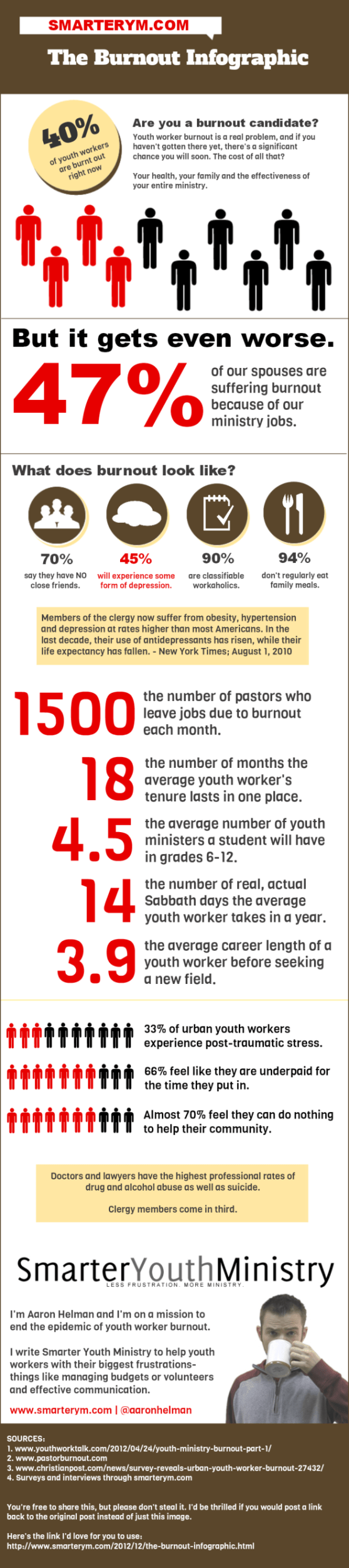
These stat are a little scary (mostly because I believe they are true). Fellow pastors and ministers, be on close guard of you time, family and personal rest. Congregation members, could I suggest you all be on the watch for warning signs of burnout in your pastors, and if seen, be part of the solution not part of the problem.

One of the scariest stat lines: 70% of youth workers say they have NO close friends. Yikes.

Watch out for this and many other warning signs that are all to often in ministry.
yp-burnout-infograph

Saturdays with C.S. Lewis – Atheism Turns Out To Be Too Simple

justiceMy argument against God was that the universe seemed so cruel and unjust. But how had I got this idea of just and unjust? A man does not call a line crooked unless he has some idea of a straight line. What was I comparing this universe with when I called it unjust? If the whole show was bad and senseless from A to Z, so to speak, why did I, who was supposed to be part of the show, find myself in such violent reaction against it?  A man feels wet when he falls into water, because man is not a water animal: a fish would not feel wet. Of course I could have given up my idea of justice by saying it was nothing but a private idea of my own. But if I did that, then my argument against God collapsed too—for the argument depended on saying that the world was really unjust, not simply that it did not happen to please my fancies. Thus in the very act of trying to prove that God did not exist—in other words, that the whole of reality was senseless—I found I was forced to assume that one part of reality—namely my idea of justice—was full of sense. Consequently, atheism turns out to be too simple. If the whole universe has no meaning, we should never have found out that it has no meaning: just as, if there were no light in the universe and therefore no creatures with eyes, we should never know it was dark. Dark would be a word without meaning.

Quotes from Mere Christianity, Part 15
C.S. Lewis, Mere Christianity (1952; Harper Collins: 2001) 38-39.

Hitler on Seeker-Sensitive Church Expansion Plans

I literally was in my office trying to muffle my laughter as I stumbled across this piece of church humor. I dont know what strategies your church uses but I am so thankful that my church has deep roots and a heart for the Gospel, not the newest fads in contemporary christianity.

Don’t take this to seriously now. I’m not trying to step on toes here. Just enjoy it for what its worth, and if you are on church staff somewhere, have a good laugh along with me. 🙂

I still chuckle to myself thinking about 8 straight hours listening to J. Vernon McGee as a punishment! Bahahaha!

Famous Last Words

“A good life lived will be better heard than famous last words.”  This creative video from Long Hollow Baptist Church, just up the road from me in Nashville, is a great reminder that we may do a bunch of dumb things in life, but in the end, how we live will speak volumes louder than our words.