Saturdays with C.S. Lewis: Forgiveness Applied > Forgiveness Understood

The central Christian belief is that Christ’s death has somehow put us right with God and given us a fresh start. Theories as to how it did this are another matter. A good many different theories have been held as to how it works; what all Christians are agreed on is that it does work. I will tell you what I think it is like…. A man can eat his dinner without understanding exactly how food nourishes him. A man can accept what Christ has done without knowing how it works: indeed, he certainly would not know how it works until he has accepted it.

We are told that Christ was killed for us, that His death has washed out our sins, and that by dying He disabled death itself. That is the formula. That is Christianity. That is what has to be believed. Any theories we build up as to how Christ’s death did all this are, in my view, quite secondary: mere plans or diagrams to be left alone if they do not help us, and, even if they do help us, not to be confused with the thing itself. All the same, some of these theories are worth looking at.

Quotes from Mere Christianity, Part 21
C.S. Lewis, Mere Christianity (1952; Harper Collins: 2001) 54-56.

Saturdays with C.S. Lewis: Letters to a Child

In his life, C.S. Lewis received thousands of letters from young fans who were eager for more knowledge of his bestselling Narnia books and their author. Here we get a glimpse of his fatherly words. Lewis writes to the children – as in the books he wrote for them – with understanding and respect, proving why he remains one of the best-loved children’s authors of all time.

One aspect of this particular letter that jumps out at me is the way in which Lewis guides the girl in her understanding of Jesus but allows room for her own spiritual discovery. Lewis is not feeding a prepackaged idea to this girl, but cultivating the soil for the Gospel to grow. He wants her to see the glories of Jesus with her own eyes! How great is that. Also, I love that fact that she sent him a bunch of drawings of the Narnian characters. This reminds me of my own 5 year old girl who draws pictures of all the things she loves.

Read these words of C.S. Lewis as he addresses a fan letter from a girl named Hila.

****************************************

Dear Hila:

Thank you so much for your lovely letter and pictures. I realized at once that the coloured one was not a particular scene but a sort of line-up like what you would have at the very end if it was a play instead of stories. The [Voyage of] “Dawn Treader” is not to be the last: There are to be 4 more, 7 in all. Didn’t you notice that Aslan said nothing about Eustace not going back? I thought the best of your pictures was the one of Mr. Tumnus at the bottom of the letter. As to Aslan’s other name, well I want you to guess. Has there never been anyone in this world who

  1. Arrived at the same time as Father Christmas.
  2. Said he was the son of the Great Emperor.
  3. Gave himself up for someone else’s fault to be jeered at and killed by wicked people.
  4. Came to life again.
  5. Is sometimes spoken of as a Lamb (see the end of the Dawn Treader).

Don’t you really know His name in this world. Think it over and let me know your answer!

Reepicheep in your coloured picture has just the right perky, cheeky expression. I love real mice. There are lots in my rooms in college but I have never set a trap. When I sit up late working they poke their heads out from behind the curtains just as if they were saying, “Hi! Time for you to go to bed. We want to come out and play.”

All good wishes,

Yours ever

C.S. Lewis

Letters to Children, June 3, 1953

Saturdays With C.S. Lewis: A Moral Law Beyond Ourselves

If the Moral Law was one of our instincts, we ought to be able to point to some one impulse inside us which was always what we call ‘good,’ always in agreement with the rule of right behaviour. But you cannot. There is none of our impulses which the Moral Law may not sometimes tell us to suppress, and none which it may not sometimes tell us to encourage. It is a mistake to think that some of our impulses–say mother love or patriotism–are good, and others, like sex or the fighting instinct, are bad. All we mean is that the occasions on which the fighting instinct or the sexual desire need to be restrained are rather more frequent than those for restraining mother love or patriotism. But there are situations in which it is the duty of a married man to encourage his sexual impulse and of a soldier to encourage the fighting instinct. There are also occasions on which a mother’s love for her own children or a man’s love for his own country have to be suppressed or they will lead to unfairness towards other people’s children or countries. Strictly speaking, there are no such things as good and bad impulses. Think once again of a piano. It has not got two kinds of notes on it, the ‘right’ notes and the ‘wrong’ ones. Every single note is right at one time and wrong at another. The Moral Law is not any one instinct or set of instincts: it is something which makes a kind of tune (the tune we call goodness or right conduct) by directing the instincts.

~C.S. Lewis, Mere Christianity, Chapter 2 (1952)

Saturdays with C.S. Lewis: Are the Gospels Legend?

“Another point is that on that view you would have to regard the accounts of the Man as being legends. Now, as a literary historian, I am perfectly convinced that whatever else the Gospels are they are not legends. I have read a great deal of legend and I am quite clear that they are not the same sort of thing. They are not artistic enough to be legends. From an imaginative point of view they are clumsy, they don’t work up to things properly. Most of the life of Jesus is totally unknown to us, as is the life of anyone else who lived at that time, and no people building up a legend would allow that to be so. Apart from bits of the Platonic dialogues, there are no conversations that I know of in ancient literature like the Fourth Gospel. There is nothing, even in modern literature, until about a hundred years ago when the realistic novel came into existence. In the story of the woman taken in adultery we are told Christ bent down and scribbled in the dust with His finger. Nothing comes of this. No one has ever based any doctrine on it. And the art of inventing little irrelevant details to make an imaginary scene more convincing is a purely modern art. Surely the only explanation of this passage is that the thing really happened? The author put it in simply because he had seen it.”
-C.S. Lewis, “What Are We to Make of Jesus Christ?” (1950)

Saturdays with C.S. Lewis: Liar, Lunatic, or Lord?

C.S. Lewis has a way with words that cut to the heart. He speaks plainly, but powerfully. In a concise bit of logic Lewis reminds us that the claims of Christ leave very limited options for us in our response. Who do you say Jesus is? Does that correspond to who He said he was? While this argument has been retold many times since Lewis set the stage, read his words anew and allow them to challenge you.

“I am trying here to prevent anyone saying the really foolish thing that people often say about Him: I’m ready to accept Jesus as a great moral teacher, but I don’t accept his claim to be God. That is the one thing we must not say. A man who was merely a man and said the sort of things Jesus said would not be a great moral teacher. He would either be a lunatic — on the level with the man who says he is a poached egg — or else he would be the Devil of Hell. You must make your choice. Either this man was, and is, the Son of God, or else a madman or something worse. You can shut him up for a fool, you can spit at him and kill him as a demon or you can fall at his feet and call him Lord and God, but let us not come with any patronizing nonsense about his being a great human teacher. He has not left that open to us. He did not intend to.”

Your fellow worker in the field, Adam


Saturdays with C.S. Lewis – Why you were brought to Narnia

 “Please Aslan, before we go, will you tell us when we can come back to Narnia again? Please. And oh, do, do, do, make it soon.”
“Dearest,” said Aslan very gently, “you and your brother will never come back to Narnia.”
“Oh, Aslan!!” said Edmund and Lucy both together in despairing voices.
“You are too old, children,” said Aslan, “and you must begin to come close to your own world now.”
“It isn’t Narnia, you know,” sobbed Lucy. “It’s you. We shan’t meet you there. And how can we live, never meeting you?”
“But you shall meet me, dear one,” said Aslan.
“Are — are you there too, Sir?” said Edmund.
“I am,” said Aslan. “But there I have another name. You must learn to know me by that name. This was the very reason why you were brought to Narnia, that by knowing me here for a little, you may know me better there.”

C.S. Lewis, The Voyage of the Dawn Treader (1952; this edition: HarperCollins, 1994) 247.

*************************************

What a beautiful picture of God who wants us to know Him. Though Aslan is a fairy tale, the God of the bible is not. He has shown Himself most fully through the person of Jesus Christ and He desires to know you! Do you know Him?

1 Timothy 2:  This is good, and it is pleasing in the sight of God our Savior, who desires all people to be saved and to come to the knowledge of the truth. For there is one God, and there is one mediator between God and men, the man Christ Jesus.

Your fellow worker in the field, Adam

Saturdays with C.S. Lewis: Where is God when I’m Grieving?

We all will face struggles in this life. That much is for sure. This week in our series, Saturdays with C.S. Lewis, we get a glimpse of Lewis’ personal struggle with the loss of his wife, Joy Davidman, after 4 years of marriage. Even better than Lewis’s words are the words of scripture. Jesus is able to understand our weaknesses and our doubts in the middle of tragedy. While He is acquainted with the pain, He endured without sin.

Hebrews 4:15-6 says, For we do not have a high priest who is unable to sympathize with our weaknesses, but one who in every respect has been tempted as we are, yet without sin. Let us then with confidence draw near to the throne of grace, that we may receive mercy and find grace to help in time of need.

C.S. Lewis helps us understand where God is in the middle of loss. He also helps us understand where we are in the middle of loss. Read this excerpt of Lewis grieving the loss of his wife:

How far have I got? Just as far, I think, as a widower of another sort who would stop, leaning on his spade, and say in answer to our inquiry, ‘Thank’ee. Mustn’t grumble. I do miss her something dreadful. But they say these things are sent to try us.’ We have come to the same point; he with his spade, and I, who am not now much good at digging, with my own instrument. But of course one must take ‘sent to try us’ the right way. God has not been trying an experiment on my faith or love in order to find out their quality. He knew it already. It was I who didn’t. In this trial he makes us occupy the dock, the witness box, and the bench all at once. He always knew that my temple was a house of cards. His only way of making me realize the fact was to knock it down.

~C.S. Lewis, A Grief Observed, 1961 (emphasis added)


Saturdays with C.S. Lewis – Aslan, You’re Bigger!

Lucy and Aslan

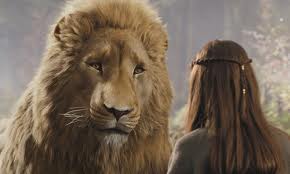
“And then—oh joy! For he was there: the huge Lion, shining white in the moonlight, with his huge black shadow underneath him. But for the movement of his tail he might have been a stone lion, but Lucy never thought of that. She never stopped to think whether he was a friendly lion or not. She rushed to him. She felt her heart would burst if she lost a moment. And the next thing she knew was that she was kissing him and putting her arms as far round his neck as she could and burying her face in the beautiful rich silkiness of his mane.
“Aslan, Aslan. Dear Aslan,” sobbed Lucy. “At last.”

The great beast rolled over on his side so that Lucy fell, half sitting and half lying between his front paws. He bent forward and just touched her nose with his tongue. His warm breath came all round her. She gazed up into the large wise face. “Welcome, child,” he said.
“Aslan,” said Lucy, “you’re bigger.” 
“That is because you are older, little one,” answered he. 
“Not because you are?” 
“I am not. But every year you grow, you will find me bigger.”

C.S. Lewis, Prince Caspian: The Return to Narnia The Chronicles of Narnia (1951, this edition Harper Collins, 1994) 141.

*********************************

It is my prayer that everyday you would be growing deeper in your relationship to the God of the universe. But as we see and understand Him more with each step, we also understand that there is infinitely more to look forward to! He is never changing, but we are always changing. He is unmovable, and we will forever be moving closer to him! One day we will look and see with eyes like Lucy, “Oh, what a huge God we serve”, but all the while knowing the closer we get to Him, the bigger He looks to us. Thank you C.S. for this analogy of understanding an infinitely awesome God!

Your fellow worker in the field,  Adam

Saturdays with C.S. Lewis

The weekend is here. I hope you enjoy some rest and relaxation somewhere in your day. Today brings a new series I want to introduce to my readers.

Saturdays with C.S. Lewis

Each Saturday as you peruse your favorite blogs and Facebook interests you can stop in here for a look at one of the most eloquent laymen ever to speak and write about Christianity. C.S. Lewis was never a preacher or a pastor. He was never employed by a church or enrolled in theological education. In fact, Lewis described himself as the “most reluctant convert” to Christianity.

C.S. Lewis was an English professor at Oxford University. After converting to Christianity as a 33 year old, he thoughtfully began to apply his faith to real life. His craft was literature, therefore he began to use his craft for the glory of God. (Just as we all should bloom where we are planted and honor God with whatever talents He has given us.)

Lewis wrote fiction and non-fiction, and is well respected for both. He knew how to connect with real life and communicate with his readers as if they were old friends.

Why do I read and respect C.S. Lewis?

Because every time I pick up one of his books 1.) he makes me think. But not just to think about the topic at hand, he trains me to think. My christian worldview is honed and sharpened whether I am traveling the battlefields of Narnia or debating the issues in Mere Christianity. Next, 2.) he makes me deal with today. Even though he wrote in a day with no blogs, Facebook or Twitter (I’d love to hear Screwtape’s take on social media) his keen eye for the heart of the issue cuts through the cultural differences and speaks to universal principles that transcend time and space. The truths of Christianity are just as true in 1941 with WWII raging as they are in 2012 with all of our current issues. Lewis reminds me to speak to our day in a way that is articulate, thoughtful, and respectful. And lastly, 3.) he is simply a joy to read. His style and flow are the work of an artist. He connects with the child as easily as the scholar. On this point I will note that while his style is intoxicating, not all is theologically correct.

I even believe he is downright wrong on some issues. This drives home the fact that we cannot be blind followers of any man. We are to follow the Lord Jesus alone. While I think Lewis has so much to offer this new generation of believers, we filter everything through the lens of scripture. When Lewis doesn’t jive with God’s Word, we see that for what it is and choose to bring every thought captive to Christ. For example, Lewis, in the final Narnia series book, The Last Battle, leaves the door open to the possibility of people entering into heaven through other faiths. I understand this to be totally wrong. Recognizing this flaw I do not discard the entire Chronicles of Narnia, but am reminded that our theology informs our fiction and not the other way around. God’s Word alone is authoritative in describing entrance into His family.

Each Saturday we will enjoy snippets from C.S. Lewis together. Through his quotes, imagery, and arguments we will see that Lewis is spiritually profitable for this generation as much as he was for his own. I look forward to hearing your comments as we open the treasure trove of the life and works of C.S. Lewis.

Your fellow worker in the field,  Adam