Biblical Illiteracy

Dr. Greg Thornbury, one of the most influential professors I had while attending Union University, has written a blog posted HERE, available through BibleMesh.com, addressing the Biblical illiteracy of our culture. While we have everything from game shows (The American Bible Challenge: with host Jeff Foxworthy) to books aimed at bible-knowledge, how well are we really doing? Are we training the next generation to understand the Bible in a way that, as Thornbury says, “everything points to the message and mission of the Lord Jesus Christ”, or are we just teaching trivial moral facts? Read and be challenged!

-Adam

*************************************************

For more than two decades now, American society has been fixated on our ignorance about things, often to the point of celebration.  In 1991, the very first For Dummies book (it was on DOS) rolled off the presses, and more than 1600 of the series have been published since then.  We’re not afraid to say when we don’t know stuff, and actually to do so is kind of therapeutic.

Sometimes, the dummy culture rises to the level of comedy, and one thing we find hilarious is our collective cluelessness about the Bible.  Years ago, Tonight Show host Jay Leno poked fun every so often at the pandemic ignorance of Holy Writ during his “Jaywalking” segment.

Biblical illiteracy is, however, no laughing matter.  Recent titles such as Timothy Beal’s The Rise and Fall of the Bible and Kenda Creasy Dean’s Almost Christian show that the problem for the Church is pandemic.  Both books demonstrate the appalling state of how little believers know about their own sacred text. How long can any organization survive if its members don’t know its mission, axioms, and core beliefs?  Well, that’s a rhetorical question.

But what if people actually did know their Bibles? Esquire writer A.J. Jacobs took up that challenge and tried to combine humor with astonishing levels of biblical literacy in his irreverent book, The Year of Living Biblically.  In it, Jacobs, an admitted agnostic, seeks to live an entire year by trying to obey the commands of the Bible as literally as he possibly could in modern day Manhattan. He found it rough going for multiple reasons, chief amongst them not being able to gossip at work, lie, or covet the possessions of others.   Rules such as stoning adulterers, slaughtering oxen, wearing clothing not made of mixed fibers, and not shaving one’s beard seemed even harder to apply to modern life.  In the end, Jacobs concludes we can’t read the Bible literally, and that in reality people just pick and choose the commands they like, and ignore the ones that they don’t.

On a more positive note, comedian Jeff Foxworthy (of “You Might Be a Redneck” and “Are You Smarter Than Your Fifth Grader?” fame) hosts a new game show called “The American Bible Challenge,” a Family Feud style format in which groups are called upon to pit their Bible knowledge against each other in purportedly knee slapping fashion.  The show bills itself this way: “Questions will be designed to acknowledge and celebrate the Bible’s continuing importance in contemporary life and culture. The contestants will share their compelling back-stories and each team will be playing for a worthy charity.”

What do all of these books, shows, and analyses have in common?  They reveal that we live in a culture that can’t live with the Bible, but also can’t seem to live without it.

At the bottom line, however, here’s the truth: the Bible is a confusing and even bizarre book.  But it is only that way if it is not read through the lenses of what the 16th century Reformer John Calvin called the “spectacles of faith” – where everything points to the message and mission of the Lord Jesus Christ.  Try to turn the Bible into a disconnected series of facts, and you might have a quiz show.  Try to squeeze the law of Moses into modern society and you get a Kafka-esque nightmare or a funny Jacobs’ book.  Read the Bible without the grace and love of Jesus to explain all that has gone before?  How many ways can you spell disaster?

Manly Pride is so Lame

So yesterday was Labor Day, so what do I naturally do with a day off to celebrate and rest from my labor? Work at home. But while my day started off fine it did not end so well.

Here is the story. We recently purchased a house so there are tons of little jobs always looming. Yesterday I was replacing the old school thermostats with new digital ones. I needed a tool from the garage so made the quick trek out to get it…barefoot (mistake #1). While navigating the clutter that comes from a recent move I tripped (mistake #2) and got a real nice two inch cut across the top of my foot. I came in and assessed the situation. The kids were upstairs entertaining themselves surprisingly well and my wife (who is a nurse) was resting in the bedroom. I decided to clean up my cut and get back to my little job without bothering anyone (mistake #3). I washed it up and covered it with multiple bandaids.

Later that night Leslie and I were talking about my incident and I offered to show her my battle scar. I peeled away the crusty bandaids and she let out a slight gasp. I then proceeded to receive a mild tongue lashing about why I did not let her see it right when it happened. She interrogated me on how I cleaned it and let me know that this gash was potentially worthy of some stitches or at least some super glue. She got out some butterfly bandages and patched it up the way it should have been done from the beginning.

I never even considered a trip to the Urgent Care office just down the road, but because of my manly pride I even missed out on the advice of my nurse trained wife!

Maybe I’m not alone. I think there are others of you out there who consider a trip the hospital the last resort. But do we also have this same mentality when it comes to spiritual matters? When we are wounded do we try to handle it all on our own?

God created us to live in community. We were never designed to be alone. Yet, when we need our brothers and sisters in Christ the most, those are the times we shrink back and isolate ourselves. Is this not a symptom of the pride still residing in our hearts? We do not want others to know that we are weak and needy. We hide our hurts. We refuse the community that God has instituted and seek our own ways. But like the lesson I learned with my foot, when left to our own devices we make bad decisions. Why not seek the advise of those who really love you and can help you?

James 5:16 reminds us of this very lesson. “Therefore confess your sins to each other and pray for each other so that you may be healed.The prayer of a righteous person is powerful and effective.”

So don’t be to prideful to ask for help, whether spiritual or physical. Manly pride is so lame, and because of it, now I am too!

Your fellow worker in the field, Adam

5 Reasons Christians Struggle to Evangelize

This article written by Greg Stier of the Christian Post hits the nail on the head. Which point is most evident in your life?  I love the way Scripture is used as “The Cure” at the end of each point. Isn’t that just way the Bible works. It always meets us where we are and shows us the way we need to adjust. Read these 5 reasons why Christians struggle to evangelize and be encouraged not guilt-ridden. The Word always points us in the right direction.

1. Fear

Sharing your faith is a scary prospect. You can lose face and friends as a result of communicating this “narrow-minded” message of the gospel even when you do so in love. When choosing between being accepted by others and sharing the good news with others too often Christians choose silence. Fear is the biggest culprit that keeps most Christians from evangelizing.

The Cure: “Pray also for me, that whenever I speak, words may be given me so that I will fearlessly make known the mystery of the gospel, for which I am an ambassador in chains. Pray that I may declare it fearlessly, as I should.” Ephesians 6:19-20

2. Ignorance

There are many Christians who, down deep inside, want to share their faith but they honestly don’t know what to say. Sadly, if you were to put a microphone in the face of the average church goer leaving a typical Sunday morning service and asked them to define the gospel message the answers could range from “um” to dumb. To add insult to injury far too many preachers have over-complicated the gospel to the point where even true Christians wonder if they are saved. They’ve added caveats and small print to John 3:16 and, as a result, many believers are confused by the clear and simple gospel that once they embraced with child-like faith.

The Cure: “For what I received I passed on to you as of first importance: that Christ died for our sins according to the Scriptures, that he was buried, that he was raised on the third day according to the Scriptures….” 1 Corinthians 15:3,4

3. Arrogance

Sadly, there are Christians who think they are above sharing the gospel. After all, isn’t that what they pay the pastor, youth leader and missionary to do? These Christians want to sing about Jesus in the sanctuary, exegete his book in Sunday school but don’t want to get their lily white hands defiled with the diseased and dirty “sinners” by having to actually talk to them.

The Cure: “And their scribes and the Pharisees complained against His disciples, saying, ‘Why do You eat and drink with tax collectors and sinners?’ Jesus answered and said to them, ‘Those who are well have no need of a physician, but those who are sick. 32 I have not come to call the righteous, but sinners, to repentance.'” Luke 5:30-32

4. Apathy

Sadly, there are many who call themselves Christians but they just don’t care about the lost. They believe there is a hell. They know that those who don’t know Jesus will go there forever. But they, for whatever reason, just don’t care. They have lost their first love and, therefore, refuse to do what he commands. And, like the church of Ephesus in Revelation 2, if they don’t start letting their little lights shine they could have their candles snuffed out altogether.

The Cure: “When he saw the crowds he had compassion on them because they were harassed and helpless, like sheep without a shepherd.” Matthew 9:36

5. Bad Theology

This brand of bad theology has a range. One extreme defangs hell by making it mythical or instantaneous suffering (as opposed to eternal) therefore removing the urgency to evangelize. The other side of the range uses the doctrine of election as a way to eradicate urgency. After all, if God is sovereign in salvation why evangelize? Although I believe in the sovereignty of God in salvation I’m also fully convinced that if people don’t hear and believe the gospel then they’ll be damned forever. I chose not to try to solve the riddle but live in the tension between God’s sovereignty and human responsibility. It is in the midst of this tension that God provides us both urgency and assurance, urgency to reach the lost who are headed to hell and assurance that God is the only one who is sovereign in salvation.

The Cure: “Therefore I endure all things for the sake of the elect, that they also may obtain the salvation which is in Christ Jesus with eternal glory.” 2 Timothy 2:10

 
Read more at http://www.christianpost.com/news/5-reasons-why-christians-struggle-to-evangelize-80702/#wP9gDptR1atjKswJ.99

Faithlife Study Bible – Combining Tech With Truth

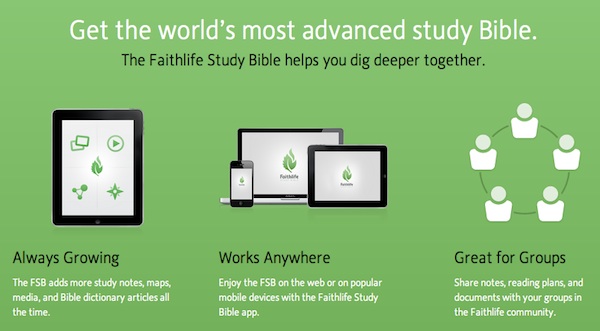
So I am all about connecting you with great resources. I have come across another FREE resource that I have spent the day using and really, really like. (the link and coupon code are at the bottom of this insightful review).  It is called the Faithlife Study Bible. It is made by Logos Bible Software (which is a very respectable company that produces quality ministry and linguistic programs).

We have all used a study bible. This app combines all the notes and scholarly writing of that study bible but without the 10 pound workout of lugging it around. Also, I believe it actually does an even better job with those notes that a hardcopy study bible because of the interactivity built into the program. As you read a passage of the bible in the frame below you can read the corresponding notes to help you go deeper. If you are really interested you can click on the “+” next to a particular note and bring up a window of more study on that topic. You can even go a third level into that particular note and bring up archeological and scholarly writing and support all in an interactive way. Wow. Super cool and super efficient. I love how you can keep going deeper and deeper as you study the scripture, but you don’t have to sift through all that info if you just want to read surface-level commentary on that particular passage. It is all there right at your fingertip when you are ready to dive in.

Another feature which promises to add a whole new dimension to your bible study is the “community” capabilities. Built into the Home screen is the ability to setup and connect with groups of other users with the app. You can get your small group at church to all interact on the scripture from the latest bible study. You could make accountability groups and do a bible reading plan. The possibilities are almost endless! I can’t wait to try this feature out and see if it is as good at it looks.

Other features it has are devotionals, a bible dictionary, full mobility on your devices, and the one I love the most: it is always growing with updated information, articles, research and usefulness. This is the joy of a interactive, web-linked study bible.

One down side is they (eventually) will be making money off this app. First off, you can currently download a free subscription for usage lasting 2 years, ending March 2014. Just long enough to get us totally hooked and dependent on the technology. But hey, 2 years is pretty generous. And I don’t mind paying for a quality bible, so lets see if it really takes to the church scene and becomes a must have addition to your bible study routine. Secondly, there is only one bible translation available in the free download. The Lexham English Bible is the sole default version. To get any of the primary bible translations used in most churches you have to pay roughly $10 per bible and download it to your Faithlife app.

Overall, I rate this resource as a must have for anyone serious about combining the technological age with biblical truth. I will be testing its effectiveness in my own student ministry, because teens thrive off technology yet I want them to thrive on the Word. This app could bridge the gap between the two.

Let me know what you think! To get the app for FREE go to www.faithlifebible.com and in the coupon code enter: JoshGriffin . I had no trouble getting it set up on my iPad in just a few minutes.

Your fellow worker in the field, Adam

Trying To Grasp The Trinity: 3 Helpful Resources

One of the hardest, yet most necessary doctrines of the Church is the Trinity. God = 3 in 1. Yikes. Sometimes people shy away from difficult teachings simply for the sake of the effort required to understand. We’ve all heard it said, “anything worth doing is worth doing right”. And the same goes for sound theology!

Here are three easy and helpful resources while trying to grasp the tough doctrine of the trinity.

  1. a 4 minute video
  2. a cool info-graphic
  3. and a short article, “What is the Trinity?

I pray these help you not just know more about God, but also grow in love and worship of our awesome God!

Your fellow worker in the field, Adam

********************************************************************************************

This is one video of a series by the Resurgence called “On the Spot”.

Here is a great info-graphic from Tim Challies that is very helpful for the visual learner.

Free High-Res jpeg version – The Trinity

My Heart Christ’s Home – Robert Boyd Munger

***note: free resource at the bottom of this article.

Today I am in packing mode. We are moving into our newly purchased home. If you have been there yourself, you understand what I am in the middle of. Therefore, I will keep it short.

Before all the packing began we bought our home and decided to fix a few things up before moving in. We have put in new countertops, floors, light fixtures, just to name a few. All this work on our home reminded me of a great little devotional book I read back when I was a teenager. My Heart, Christ’s Home.

This booklet was introduced to me at a time when I was growing by leaps and bounds in my spiritual life. Munger compares our heart to the layout of a home. He walks us through each “room” of our heart and discusses the implications of having Jesus taking up residence there. In the living room we prepare to meet Christ daily. In the dining room we examine together what appetites should and should not control us. We even explore the closets in our lives that Christ can help us clean out.

Munger’s practical yet profound booklet helps you give Christ control over all of your life. I did a little bit of internet hunting and found locations for this resource.

Download the PDF of this great booklet for free HERE, or buy printed copies in a 5 pack for cheap HERE. Everyone should take the time to read through this and perform some self examination.

Your fellow worker in the field, Adam

The Response That Was Left Unsaid: This Is How Hate Sounds

This powerful fictional letter written by David Murray, of HeadHeartHand.org and PRT Seminary, is one of the best examples of love communicated to a homosexual son I have seen. Unfortunately, the fictional letter was preceded by an actual letter of father disowning his son. Read all the way to the end and see the differences.

The best line, worthy of being quoted: “I hope you will not call this message hate. This is how love sounds.”

Check out the original article here.

*************************************

Five years ago, Redditor RegBarc ”came out” to his father. Shortly afterwards, his dad disowned him in a handwritten letter which RegBarc shared with the world on Tuesday, adding the comment: “This is how hate sounds.”

James:

This is a difficult but necessary letter to write.

I hope your telephone call was not to receive my blessing for the degrading of your lifestyle. I have fond memories of our times together, but that is all in the past.

Don’t expect any further conversations with me. No communications at all.

I will not come to visit, nor do I want you in my house.

You’ve made your choice, though wrong it may be. God did not intend for this unnatural lifestyle.

If you choose not to attend my funeral, my friends and family will understand.

Have a good birthday and good life.

No present exchanges will be accepted.

Good bye, Dad

As I find it hard to believe that a true Christian would ever write such a letter, I’ve drafted a letter that I hope a Christian father would write (although I’m sure we all hope we’ll never have to write it).

My dear James,

I’d rather say this man-to-man and face-to face, and I hope I will have a chance to do so soon. However, to avoid misunderstanding, and to ensure that you have something in black and white you can keep and refer to, I want to make sure you know one thing: I love you, and I always will. I do not hate you, and I never will.

Our relationship will probably change a bit as a result of your chosen lifestyle, but my love for you will never change. I will continue to seek your very best, as I have always done. In fact, I will probably, by prayer and other practical means, seek your good as I’ve never done before.

Maybe you’ve been afraid that I will reject you and throw you out of my life. I want you to know that you will always be welcome in our family home. Text, email, phone regularly. I certainly will. We’d especially love you to come home for birthdays and for other special occasions. I hope we can continue to go fishing together and to share other areas of our lives.

Your male friend may also visit our home with you, but we will need to discuss certain boundaries. For example, I can’t allow you to share a room or a bed together when you are here, and I will not allow open displays of affection for one another, especially in front of the other children. If you stay with us, you will attend family devotions, and if you are with us on a Sunday, you will come to church with us to hear the Gospel.

Perhaps these boundaries are not going to be easy for you to accept, but please try to understand that I have a duty to God to lead my home in a God-glorifying manner. Psalm 101 commands me to prevent sinful behavior in my home. While extremely anxious to preserve a relationship with you, I am especially concerned that your siblings are not influenced into thinking your lifestyle is fine with God or us.

I know that you don’t like me calling your lifestyle and sexual practices a sin. However, remember I’ve always told you that I myself am a great sinner, but I have an even greater Savior. I hope the day will come when you will seek that great Savior for yourself. He can wash us snow-white clean. He is also able to deliver us from the bondage of our lusts and from everlasting damnation.

I will not bring up your sin and the Gospel every time we meet, but I do want you to know where I stand right up front, and also that I’m willing to speak with you about the Gospel of Christ anytime you wish.

I hope you will not call this message hate. This is how love sounds.

I will always be your Dad. And you will always be my son.

As I will never stop loving you, I will never stop praying for you.

With all my love,

Dad (Ps. 103:13).


Worshiping Through “Beautiful Things” by Gungor

I just returned home from Cincinnati, OH where I took a mission team of teenagers and chaperones to assist a brand new church plant. Velocity Church, led by Pastor Steve Staton, held their very first service last weekend. I was blown away by God’s presence when his people meet together in His name. As the Velocity band played, this song led me to the throne room and reminded me again what an awesome God I serve. I hope as you watch and listen, you to will take a moment to let your heart worship even while sitting at your computer!

Beautiful Things –  Gungor

All this pain
I wonder if I’ll ever find my way?
I wonder if my life could really change at all?
All this earth
Could all that is lost ever be found?
Could a garden come up from this ground at all?

You make beautiful things
You make beautiful things out of the dust
You make beautiful things
You make beautiful things out of us

All around
Hope is springing up from this old ground
Out of chaos life is being found in You

You make beautiful things
You make beautiful things out of the dust
You make beautiful things
You make beautiful things out of us

Oh, you make beautiful things
You make beautiful things out of the dust
You make beautiful things
You make beautiful things out of us

You make me new, You are making me new
Making me new

You make beautiful things
(You make me new)
You make beautiful things out of us
(You are making me new, making me new)

Oh, you make beautiful things
(You make me new)
You make beautiful things out of the dust
(You are making me new, making me new)

You make beautiful things
You make beautiful things out of the dust

You make me new, You are making me new

One Year Later: Remembering John Stott

One year ago today, July 27th, 2011 the humble preacher, author, and theologian John Stott passed away. I want to take this article, just in case you have never heard of this man, to reflect on some of his legacy.

Some of my favorite Stott quotes:

  • Every Christian should be both conservative and radical; conservative in preserving the faith and radical in applying it.
  • Before we can begin to see the cross as something done for us, we have to see it as something done by us.
  • His authority on earth allows us to dare to go to all the nations. His authority in heaven gives us our only hope of success. And His presence with us leaves us with no other choice.
  • The truth is that there are such things as Christian tears, and too few of us ever weep them.

As described in an obituary by Christianity Today, Stott was “An architect of 20th-century evangelicalism [who] shaped the faith of a generation.” When he passed away the BBC referred to him as someone who could “explain complex theology in a way lay people could easily understand”. Billy Graham said of him, “The evangelical world has lost one of its greatest spokesmen, and I have lost one of my close personal friends and advisors. I look forward to seeing him again when I go to Heaven.”

An incredibly influential work that John Stott wrote was “The Cross of Christ”. At a time when a substitutionary view of the Atonement of Christ was under attack, Stott addressed the issue with grace and truth. Of this book J. I. Packer stated, “No other treatment of this supreme subject says so much so truly and so well.”

While Stott has some theological differences from myself, [for rarely (if ever) can you agree with every single belief of another man], I respect his heart for Christ and the legacy of biblical passion he has left behind for evangelicalism. I pray that more teachers of the faith will rise up like him and shake our generation as he shook his.

Your fellow worker in the field, Adam