Self-Defeating Statements People (Unwittingly) Use Everyday!

“There is no truth!”

How many times have you heard that before?

In their book I Don’t Have Enough Faith to Be an Atheist, authors Norman Geisler and Frank Turek provide one of the most valuable tools and tactics a clear-thinker needs to master and have in their arsenal:

“If someone said to you, ‘I have one insight for you that absolutely will revolutionize your ability to quickly and clearly identify the false statements and false philosophies that permeate our culture,’ would you be interested? That’s what we’re about to do here. In fact, if we had to pick just one thinking ability as the most valuable we’ve learned in our many years of seminary and postgraduate education, it would be this: how to identify and refute self-defeating statements.”(i)

What is a self-defeating statement?

A self-defeating (or self-refuting) statement is one that fails to meet its own standard. In other words, it is a statement that cannot live up to its own criteria. Imagine if I were to say,

I cannot speak a word in English.

You intuitively see a problem here. I told you in English that I cannot speak a word in English. This statement is self-refuting. It does not meet its own standard or criteria. It self-destructs.

The important thing to remember with self-defeating statements is that they are necessarily false. In other words, there is no possible way for them to be true. This is because they violate a very fundamental law of logic, the law of non-contradiction. This law states that A and non-A cannot both be true at the same time and in the same sense. For example, it is not possible for God to exist and not exist at the same time and in the same sense. This would violate the law of non-contradiction. So if I were to say, “God told me He doesn’t exist” you would see intuitively the obvious self-refuting nature of this statement.

How do you expose self-defeating statements?

Simple: you apply the claim to itself. This is what Geisler and Turek call the Road Runner Tactic and what Greg Koukl refers to as The Suicide Tactic (see chapter 7 of his book Tactics).

Below each self-defeating statement is an explanation of why it commits suicide along with suggestions on how you can respond. If this is your first time dealing with self-refuting statements you may need to read them a couple times. Stop and reflect on what the statement is saying and then see if you can identify its self-refuting nature.

1. There is no truth.

If there is no truth this statement itself cannot be true. Therefore, truth exists. You cannot deny truth without affirming it. You might respond, “Is that true?” or “How can it be true that there is no truth?”

2. You can’t know truth.

If you can’t know truth then you would never know that “you can’t know truth.” This person is claiming to know the truth that wecan’t know truth. You might respond, “Then how do you know that?”

3. No one has the truth.

This person is claiming to have the truth that no one has the truth. If no one has the truth then the statement “no one has the truth” is false! You might respond, “Then how do you know that is true?”

4. All truth is relative.

Sometimes also stated as “Everything is relative.” If all truth is relative then this statement itself would be relative and not objectively true. In other words, the person is claiming that it is objectively true that all truth is relative. You might respond, “Isthat a relative truth?”

5. It’s true for you but not for me.

This statement is self-refuting because it claims that truth is relative to the individual and yet at the same time implies it is objectively true that something can be “true for you but not for me.” This statement commits the self-excepting fallacy. You might respond, “Is that just true for you, or is it true for everybody?”

6. There are no absolutes.

This statement is an absolute statement about reality that claims there are no absolutes. You might respond, “Are you absolutely sure about that?”

7. No one can know any truth about religion.

This person is claiming to know the truth about religion and it is this: you can’t know truth about religion. You might respond, “Then how did you come to know that truth about religion?”

8. You can’t know anything for sure.

If you can’t know anything for sure then you would never know it! This person is claiming to know with certainty that you can’t know anything for sure. You might respond, “Then how do you know that for sure?”

9. You should doubt everything.

If you should doubt everything then you should doubt the truth of the statement “you should doubt everything.” You might respond, “Should I doubt that?” And remember: always doubt your doubts!

10. Only science can give us truth.

If only science can give us truth we could never know that “only science can give us truth” because this is not something science can tell you! That is because this statement is philosophical in nature rather than scientific. You might respond, “What science experiment taught you that?” or “What is your scientific evidence that only science can give us truth?”

11. You can only know truth through experience.

If you can only know truth through experience you would never know the truth of the statement “you can only know truth through experience” because this is not something that can be known through experience. You might respond, “Can you know that truth through experience?” or “What experience taught you that?”

12. All truth depends on your perspective.

If all truth depends on your perspective then even the truth “all truth depends on your perspective” depends on your perspective. This is another objective statement which claims relativism is true. Again, it commits the self-excepting fallacy. You might respond, “Does that truth depend on your perspective?”

13. You shouldn’t judge.

The person who says this is making a judgment, namely, that it is wrong to judge! You might respond, “If it is wrong to judge, then why are you judging?”

14. You shouldn’t force your morality on people.

This person is forcing their moral point of view that it is wrong to force a moral point of view. You might respond, “Then please don’t force your moral view that it is wrong to force morality.”

15. You should live and let live.

The person who tells you to “live and let live” isn’t allowing you to live how you want! They are prescribing behavior for you rather than taking their own advice. You might respond, “If that’s your philosophy, why are you telling me how to live?”

16. God doesn’t take sides.

If God doesn’t take sides then He does in fact take the side that doesn’t take sides. You might respond, “Does God take thatside?”

17. You shouldn’t try to convert people.

This person is trying to convert you to their position that it is wrong to convert people! You might respond, “If it is wrong to convert, why are you trying to convert me?”

18. That’s just your view.

This statement is self-refuting if it treats an objective statement as if it were subjective. This is the subjectivist fallacy. The hidden assumption is that your view is relative and a matter of personal opinion. If that is the case, this statement can also be relativized and made into a matter of personal opinion. You might respond, “Well that’s just your view that this is just my view.”

19. You should be tolerant of all views.

Most statements regarding tolerance are self-refuting if by “tolerance” the person means “accepting all views as equally true and valid.” If that is the case, the person who says “You should be tolerant of all views” isn’t being tolerant of your view! You might respond, “Then why don’t you tolerate my view?”(ii)

20. It is arrogant to claim to have the truth.

This person is claiming to have the truth that “it is arrogant to claim to have the truth.” Therefore, by his own standard, he is the arrogant one! You might respond, “My that is awfully arrogant of you!”

_________________________________________________

Why list out these statements?

3 reasons:

So you can (1) recognize self-defeating statements, (2) expose them for what they are, and (3) avoid being caught off guard and taken in by them.
_________________________________________________

(i) Geisler and Turek, I Don’t Have Enough Faith to Be an Atheist, 38.

(ii) Note: true tolerance means “putting up with error” and carries with it the idea of respect and value with regards to persons. This is in contradistinction to the postmodern definition of tolerance which means holding all truth claims as equally true and valid.

Remembering 9/11

Today we remember 9/11. Every generation has an event that changes everything. One of those events that you can remember where you were the moment it happened. For some it is where they were and what they were doing when they heard that President John F. Kennedy was assassinated. For others it was the moment when the Space Shuttle Challenger exploded on liftoff.

I can read about those events, but I did not experience them. 9/11 I experienced.

I remember the morning. I’m sure these details will stay with me for the remainder of my life. I was a junior in college. I was getting ready for class. One of my roommates, Nathan, had on his TV and all of a sudden gets the room’s attention saying we all needed to see this. Me and 3 guys huddled around his small TV set and watched the televised terrorist attack on the Twin Towers. We saw the second plane come flying in. We skipped class not knowing what was happening elsewhere in the nation. There was a sense of gravity in every moment. The world was changed forever.

That day will never be forgotten. Today we will remember the bravery and the tragedy that took place eleven years ago. My prayers will continue to go out for those people for whom this day is one of the hardest days of the year.

Check out National Geographic’s photo tribute as a memorial of this infamous day.

Living day by day in His grace,  -Adam

Biblical Illiteracy

Dr. Greg Thornbury, one of the most influential professors I had while attending Union University, has written a blog posted HERE, available through BibleMesh.com, addressing the Biblical illiteracy of our culture. While we have everything from game shows (The American Bible Challenge: with host Jeff Foxworthy) to books aimed at bible-knowledge, how well are we really doing? Are we training the next generation to understand the Bible in a way that, as Thornbury says, “everything points to the message and mission of the Lord Jesus Christ”, or are we just teaching trivial moral facts? Read and be challenged!

-Adam

*************************************************

For more than two decades now, American society has been fixated on our ignorance about things, often to the point of celebration.  In 1991, the very first For Dummies book (it was on DOS) rolled off the presses, and more than 1600 of the series have been published since then.  We’re not afraid to say when we don’t know stuff, and actually to do so is kind of therapeutic.

Sometimes, the dummy culture rises to the level of comedy, and one thing we find hilarious is our collective cluelessness about the Bible.  Years ago, Tonight Show host Jay Leno poked fun every so often at the pandemic ignorance of Holy Writ during his “Jaywalking” segment.

Biblical illiteracy is, however, no laughing matter.  Recent titles such as Timothy Beal’s The Rise and Fall of the Bible and Kenda Creasy Dean’s Almost Christian show that the problem for the Church is pandemic.  Both books demonstrate the appalling state of how little believers know about their own sacred text. How long can any organization survive if its members don’t know its mission, axioms, and core beliefs?  Well, that’s a rhetorical question.

But what if people actually did know their Bibles? Esquire writer A.J. Jacobs took up that challenge and tried to combine humor with astonishing levels of biblical literacy in his irreverent book, The Year of Living Biblically.  In it, Jacobs, an admitted agnostic, seeks to live an entire year by trying to obey the commands of the Bible as literally as he possibly could in modern day Manhattan. He found it rough going for multiple reasons, chief amongst them not being able to gossip at work, lie, or covet the possessions of others.   Rules such as stoning adulterers, slaughtering oxen, wearing clothing not made of mixed fibers, and not shaving one’s beard seemed even harder to apply to modern life.  In the end, Jacobs concludes we can’t read the Bible literally, and that in reality people just pick and choose the commands they like, and ignore the ones that they don’t.

On a more positive note, comedian Jeff Foxworthy (of “You Might Be a Redneck” and “Are You Smarter Than Your Fifth Grader?” fame) hosts a new game show called “The American Bible Challenge,” a Family Feud style format in which groups are called upon to pit their Bible knowledge against each other in purportedly knee slapping fashion.  The show bills itself this way: “Questions will be designed to acknowledge and celebrate the Bible’s continuing importance in contemporary life and culture. The contestants will share their compelling back-stories and each team will be playing for a worthy charity.”

What do all of these books, shows, and analyses have in common?  They reveal that we live in a culture that can’t live with the Bible, but also can’t seem to live without it.

At the bottom line, however, here’s the truth: the Bible is a confusing and even bizarre book.  But it is only that way if it is not read through the lenses of what the 16th century Reformer John Calvin called the “spectacles of faith” – where everything points to the message and mission of the Lord Jesus Christ.  Try to turn the Bible into a disconnected series of facts, and you might have a quiz show.  Try to squeeze the law of Moses into modern society and you get a Kafka-esque nightmare or a funny Jacobs’ book.  Read the Bible without the grace and love of Jesus to explain all that has gone before?  How many ways can you spell disaster?

Saturdays with C.S. Lewis: No Fluff Words Needed

And now we begin to see what it is that the New Testament is always talking about. It talks about Christians ‘being born again’; it talks about them ‘putting on Christ’; about Christ ‘being formed in us’; about our coming to ‘have the mind of Christ’.
Put right out of your head the idea that these are only fancy ways of saying that Christians are to read what Christ said and try to carry it out—as a man may read what Plato or Marx said and try to carry it out. They mean something much more than that. They mean that a real Person, Christ, here and now, in that very room where you are saying your prayers, is doing things to you. It is not a question of a good man who died two thousand years ago. It is a living Man, still as much a man as you, and still as much God as He was when He created the world, really coming and interfering with your very self; killing the old natural self in you and replacing it with the kind of self He has. At first, only for moments. Then for longer periods. Finally, if all goes well, turning you permanently into a different sort of thing; into a new little Christ, a being which, in its own small way, has the same kind of life as God; which shares in His power, joy, knowledge and eternity.

C.S. Lewis, Mere Christianity (1952; Harper Collins: 2001) 191-192.

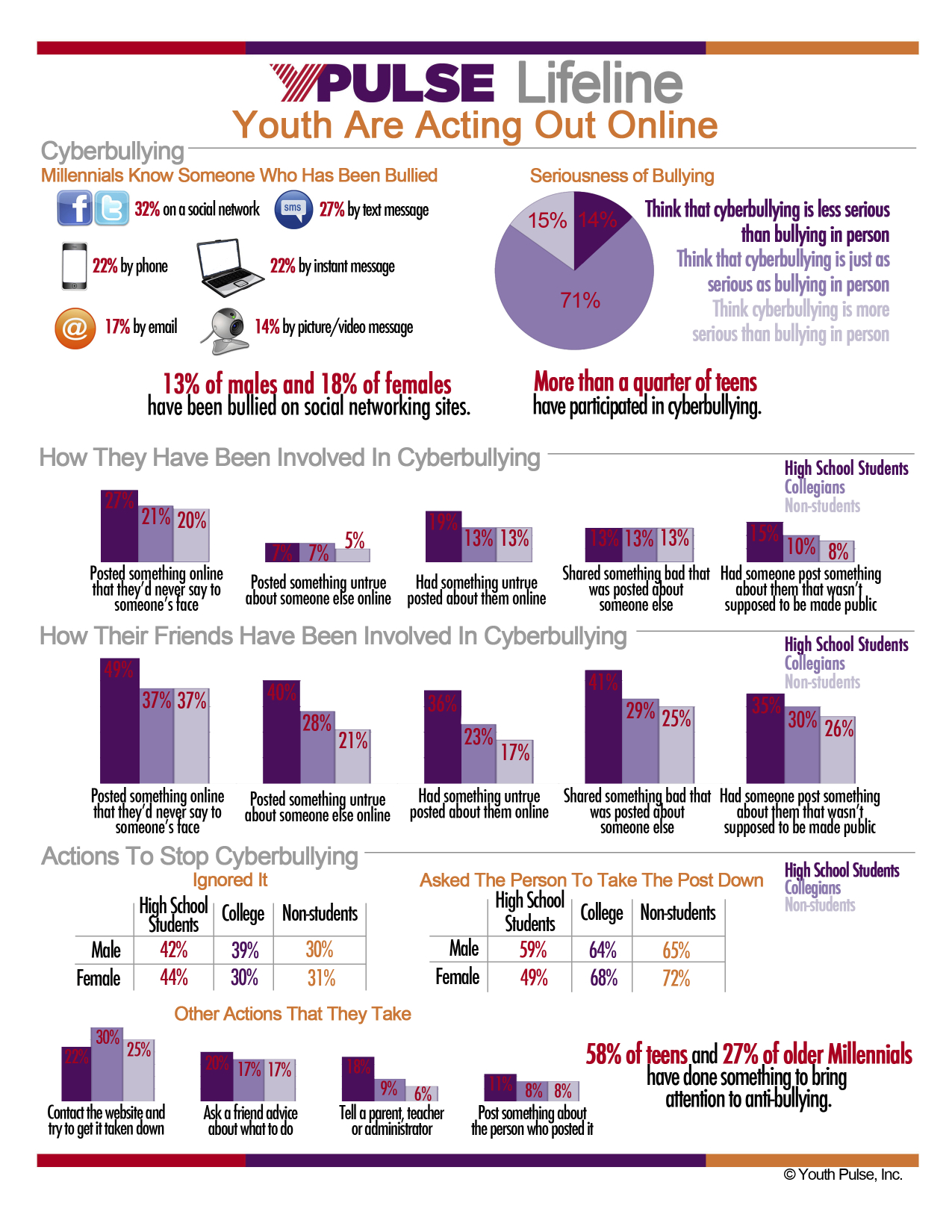
Cyberbullying: Stats About Youth Acting Out Online

Lecrae, TobyMac, Owl City: Christian Music Making Mainstream Waves


We all know that music is a huge influencer in the lives of teenagers. They live and breathe it. Here are some amazing artists who are rising to the top of their field, receiving recognition in both christian and mainstream venues. Check out this encouraging article I found.

***************************************************************

What an amazing 14 days!

Two weeks ago today, Owl City‘s new album “The Midsummer Station” released and immediately climbed to #1 on the iTunes album chart. Last week, tobyMac‘s “Eye On It” landed at #1 on that same chart, causing more than one music fan to scratch their heads and say “toby WHO?”

And then today, Lecrae‘s much anticipated (by me and a whole lot of other people) “Gravity” shot up the chart … as of noon it’s the #1 album on iTunes.

When stuff like this happens, I usually do one of two things: I get wrapped up in the excitement of it (I admit it, I kept checking iTunes every 30 minutes this morning watching Lecrae climb those last few spots to the top). Or, I write it off as “just numbers” (I’m a pessimist at heart).

But today I was really struck by how much of a God thing this is. Think about it. In the last two weeks, three incredibly talented artists — three believers who have followed a call to use their talents to glorify their Maker — have had their work showcased alongside Carrie Underwood, Maroon 5, One Direction, John Mayer … the “best” of pop music. People from around the world, not just those that regularly listen to or seek out Christian music, are being exposed to great music that was written to reflect the true Light into a dark world.

[check out this tweet by Lecrea]

#GodIsGood
But God isn’t always easy. Adam, tobyMac and Lecrae (and countless other artists, musicians and songwriters) spend weeks on the road away from family and friends, and long days (and nights) in the studio. But they keep doing it because they know it’s their gift. Their calling. Their platform. And landing on the iTunes chart isn’t about success; it’s about a bigger platform.

So thanks guys, for the great new music … and for the reminder that as Christ-followers we are all called to embrace our God-given talents, exercise our gifts and strive to use them to honor the One who gave them to us.

*********************************************************

Reblogged from Interlinc Music Resources. Thank you for this article Sheridyn Williamson and keeping us up to date in the christian music industry!

-Adam


Funny Baptism Videos

Baptisms are great. I love watching them, I love doing them. What a great picture of the death, burial, and resurrection of Jesus seen in a life of a new believer. But sometimes they don’t go so smooth! Here are some hilarious baptisms caught on camera.

The Original Classic:

The Reluctant Participant:

The Swimmer:

The Falling Pastor:

Manly Pride is so Lame

So yesterday was Labor Day, so what do I naturally do with a day off to celebrate and rest from my labor? Work at home. But while my day started off fine it did not end so well.

Here is the story. We recently purchased a house so there are tons of little jobs always looming. Yesterday I was replacing the old school thermostats with new digital ones. I needed a tool from the garage so made the quick trek out to get it…barefoot (mistake #1). While navigating the clutter that comes from a recent move I tripped (mistake #2) and got a real nice two inch cut across the top of my foot. I came in and assessed the situation. The kids were upstairs entertaining themselves surprisingly well and my wife (who is a nurse) was resting in the bedroom. I decided to clean up my cut and get back to my little job without bothering anyone (mistake #3). I washed it up and covered it with multiple bandaids.

Later that night Leslie and I were talking about my incident and I offered to show her my battle scar. I peeled away the crusty bandaids and she let out a slight gasp. I then proceeded to receive a mild tongue lashing about why I did not let her see it right when it happened. She interrogated me on how I cleaned it and let me know that this gash was potentially worthy of some stitches or at least some super glue. She got out some butterfly bandages and patched it up the way it should have been done from the beginning.

I never even considered a trip to the Urgent Care office just down the road, but because of my manly pride I even missed out on the advice of my nurse trained wife!

Maybe I’m not alone. I think there are others of you out there who consider a trip the hospital the last resort. But do we also have this same mentality when it comes to spiritual matters? When we are wounded do we try to handle it all on our own?

God created us to live in community. We were never designed to be alone. Yet, when we need our brothers and sisters in Christ the most, those are the times we shrink back and isolate ourselves. Is this not a symptom of the pride still residing in our hearts? We do not want others to know that we are weak and needy. We hide our hurts. We refuse the community that God has instituted and seek our own ways. But like the lesson I learned with my foot, when left to our own devices we make bad decisions. Why not seek the advise of those who really love you and can help you?

James 5:16 reminds us of this very lesson. “Therefore confess your sins to each other and pray for each other so that you may be healed.The prayer of a righteous person is powerful and effective.”

So don’t be to prideful to ask for help, whether spiritual or physical. Manly pride is so lame, and because of it, now I am too!

Your fellow worker in the field, Adam

Saturdays With C.S. Lewis: We All Make Excuses

It seems, then, we are forced to believe in a real Right and Wrong. People may be sometimes mistaken about them, just as people sometimes get their [math] wrong; but [Right and Wrong] are not a matter of mere taste and opinion any more than the multiplication tables… I hope you will not misunderstand what I am going to say. I am not preaching, and Heaven knows I do not pretend to be better than anyone else. I am only trying to call attention to a fact; the fact that this year, or this month, or, more likely, this very day, we have failed to practise ourselves the kind of behaviour we expect from other people. There may be all sorts of excuses for us. That time you were so unfair to the children was when you were very tired.That slightly shady business about the money—the one you have almost forgotten—came when you were very hard-up. And what you promised to do for old So-and-so and have never done—well, you never would have promised if you had known how frightfully busy you were going to be. And as for your behaviour to your wife (or husband) or sister (or brother) if I knew how irritating they could be, I would not wonder at it—and who the dickens am I, anyway? I am just the same. That is to say, I do not succeed in keeping the Law of Nature very well, and the moment anyone tells me I am not keeping it, there starts up in my mind a string of excuses as long as your arm. The question at the moment is not whether they are good excuses. The point is that [these excuses] are one more proof of how deeply, whether we like it or not, we believe in the Law of Nature. If we do not believe in decent behaviour, why should we be so anxious to make excuses for not having behaved decently?

C.S. Lewis, Mere Christianity (1952, this edition: 2001) 7-8.