The Halloween Spectrum – Understanding the Evangelical Community

Dr. Russell Moore presents a great little comparison the terms “evangelical” and “fundamental” using the filter of Halloween. If you have a hard time understanding the nuances in these christian circles, I think this helps. And it is pretty accurate!

See the original article here.

The Halloween spectrum within Evangelical Christianity:

  • An evangelical is a fundamentalist whose kids dress up for Halloween.
  • A conservative evangelical is a fundamentalist whose kids dress up for the church’s “Fall Festival.”
  • A confessional evangelical is a fundamentalist whose kids dress up as Zwingli and Bucer for “Reformation Day.”
  • A revivalist evangelical is a fundamentalist whose kids dress up as demons and angels for the church’s Judgment House community evangelism outreach.
  • An Emerging Church evangelical is a fundamentalist who has no kids, but who dresses up for Halloween anyway.
  • A fundamentalist is a fundamentalist whose kids hand out gospel tracts to all those mentioned above.

10 Questions a Pro-Choice Candidate Is Never Asked by the Media – by Trevin Wax

Debate moderators and reporters love to ask pro-life candidates hard questions about abortion. Curiously, they don’t do the same for pro-choice candidates. Trevin Wax provides some eye-opening questions. (see the original article here.)

Here are 10 questions you never hear a pro-choice candidate asked by the media:

1. You say you support a woman’s right to make her own reproductive choices in regards to abortion and contraception. Are there any restrictions you would approve of?

2. In 2010, The Economist featured a cover story on “the war on girls” and the growth of “gendercide” in the world – abortion based solely on the sex of the baby. Does this phenomenon pose a problem for you or do you believe in the absolute right of a woman to terminate a pregnancy because the unborn fetus is female?

3. In many states, a teenager can have an abortion without her parents’ consent or knowledge but cannot get an aspirin from the school nurse without parental authorization. Do you support any restrictions or parental notification regarding abortion access for minors?

4. If you do not believe that human life begins at conception, when do you believe it begins? At what stage of development should an unborn child have human rights?

5. Currently, when genetic testing reveals an unborn child has Down Syndrome, most women choose to abort. How do you answer the charge that this phenomenon resembles the “eugenics” movement a century ago – the slow, but deliberate “weeding out” of those our society would deem “unfit” to live?

6. Do you believe an employer should be forced to violate his or her religious conscience by providing access to abortifacient drugs and contraception to employees?

7. Alveda King, niece of Martin Luther King, Jr. has said that “abortion is the white supremacist’s best friend,” pointing to the fact that Black and Latinos represent 25% of our population but account for 59% of all abortions. How do you respond to the charge that the majority of abortion clinics are found in inner-city areas with large numbers of minorities?

8. You describe abortion as a “tragic choice.” If abortion is not morally objectionable, then why is it tragic? Does this mean there is something about abortion that is different than other standard surgical procedures?

9. Do you believe abortion should be legal once the unborn fetus is viable – able to survive outside the womb?

10. If a pregnant woman and her unborn child are murdered, do you believe the criminal should face two counts of murder and serve a harsher sentence?

Visual Guide to Budgeting Your Money

Did you know that Jesus had a ton to say about money? This infographic is not “christian” but affirms common sense wisdom consistent with the bible. I know I have a long way to go in this, but I want to be putting resources out there that really connect with real life. Check out these budgeting tips.

Mormons in America


In light of the front running presidential candidate, Mitt Romney, being Mormon, I thought I’d post this informative graphic that really puts some numbers behind this religion. While less than 2% of America identifies themselves as Mormon, their presence and influence is surly on the rise. 

Saturdays with C.S. Lewis – Diminishing The Glory Of God?

Those Divine demands which sound to our natural ears most like those of a despot and least like those of a lover, in fact marshal us where we should want to go if we knew what we wanted. He demands our worship, our obedience, our prostration. Do we suppose that they can do Him any good, or fear, like the chorus in Milton, that human irreverence can bring about ‘His glory’s diminution’? A man can no more diminish God’s glory by refusing to worship Him than a lunatic can put out the sun by scribbling the word ‘darkness’ on the walls of his cell. But God wills our good, and our good is to love Him (with that responsive love proper to creatures) and to love Him we must know Him: and if we know Him, we shall in fact fall on our faces.

C.S. Lewis, The Problem of Pain (New York: HarperCollins Publishers, 1996), pp. 46-47.

World of Religion – Infographic


This graphic gives a visual understanding of the size of religious groups on the earth. Pretty cool stuff. Click anywhere on the graphic to zoom in and read the text.

John Piper Reflects on the Awesomeness of Jeremiah 32:40

In this inspiring 3 minute clip, John Piper exudes with passion as he highlights the ramifications of Jeremiah 32:40. At one point he says, “I can’t imagine any greater verse in the Bible”.

Wow. The infinite heart of God is engaged in doing us infinite good. Mind blown. Watch it and see.

7 Insights To Make Your Internship Count

I had the privilege of being an intern during my years at Union University. While that was over a decade ago now those formative experiences as an intern were me cutting my teeth in ministry. I will always think fondly of Northbrook Church and the ways I was stretched to do and be more than I ever thought I could. It is cool to reconnect with those relationships that grew from those years. Whether it is the pastors of the church, my fellow interns, or the student (who are grown with kids of their own now) I am reminded how what really matters in ministry is relationships built for the glory of God.

Below are seven great insights by Ryan Kearns of the Resurgence Blog, on how to make the intern experience as beneficial as possible. It doesn’t matter if you are the intern or the boss, in ministry or business, read through these and click the scriptural references to see the biblical backing.

One of my mentors during those formative years always used to say, “you pay your dues upfront”. I have found that to be true the older I get and it is a constant reminder that the best is yet to come!

Happy Interning!

***************************************

Looking back on my experience years ago as an intern and hearing the stories of many others, I have come to see seven critical things that make all the difference in how the intern experience plays out.

1. HAVE HUMILITY

It is impossible to be taught anything when you think you already know everything (Prov. 11:2). While the leader in you may struggle at times with the methods of the leaders you are interning under, remember this is a time for you to learn and serve, not direct. It is important to keep in mind that the Lord is teaching you a posture of how to serve and submit to authority, more than teaching you how to lead a ministry (1 Peter 5:5). Humility is often the key formative matter that the Lord wants to cultivate in you, so you may flourish over the long haul in ministry.

2. BE A GENERALIST, NOT A SPECIALIST

While you may intern in a specific area or department, keep in mind that you are there to serve the whole church. At times you may be asked to serve in ways you did not expect. Don’t worry as much about what your role is, but rather where you can be of service. The best interns are looking to get exposure and learn as much as they can about all of the church and her mission. This leads to the next point.

3. IT’S ALWAYS YOUR JOB

Be ready to take on any task as an intern. Keeping this attitude will prevent you from getting bitter or grumbling when something is asked of you that you don’t want to do. “It’s not my job” should never be a phrase that comes out of your mouth when your leaders have a need. Besides, being a person who can get things done and is known as such will serve you well for the rest of your life and ministry (Col. 3:23–24).

4. TALK ABOUT EXPECTATIONS

Know what is expected of you, and communicate what you are expecting. The frustrations of many interns come from having unrealistic or vague expectations of what their internship will look like. You will likely not be preaching regularly, setting the vision for the church, or making important church-wide decisions. Write out what your expectations are and find out if they are realistic.

5. GET FEEDBACK

There is nothing more painful and at the same time beneficial as honest feedback (Prov. 27:6). Yet many avoid it because they just don’t want to hear it. You must know that it is through critical feedback that your greatest growth is (Prov. 19:20). If you are serious about becoming a leader, finding out how God has wired you, and getting to where God wants you, then you will be dogmatic in asking for brutally honest feedback—and not just asking once, but constantly.

6. HAVE A SENSE OF SELF-AWARENESS

Out of getting good feedback should come the most underrated leadership quality of all: self-awareness. Your internship is a prime opportunity to truly be honest about who you are and who you aren’t (Rom. 12:3). Let your leaders, the experiences you are having, and the voices of community chime in during your internship to reveal to you what you are actually good at, not what you want to be good at. Self-awareness is growing in contentment with the gifts that God has actually given you and not dwelling on the gifts you wish he did. God did not get it wrong when he gave you the gifts he gave you.

7. OWN IT

And if you really want to catapult your self-awareness through feedback, then own your development and initiate the conversations and relationships that you need to. Often, an intern can feel like he or she is not being developed or poured into, and while that may be the case, take responsibility for your own development and seek out the leaders, books, and people you need to learn from. This will be how ministry looks anyway for the rest of your life, so begin to build the habit now of proactively owning your development. It is you whom Jesus expects to best steward and cultivate the gifts that he has given you (2 Tim. 2:15).

Check out Ryan’s original blog Here.

There are no “Nones”

A great reminder from my pastor, Mike Lee, in regards to the latest study by “The Pew Report”.

Study Shows Protestant Decline Below 50% in the U.S. – My Thoughts on Why.

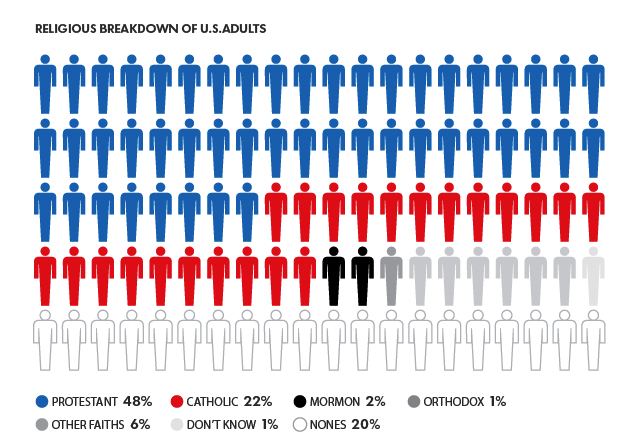
For the first time in U.S. history Protestantism (aka: anyone in the Christian tradition who is not Catholic) has fallen below 50%. The primary reason for this shift is the increase in those who claim no religion.

The Pew Forum on Religion & Public Life released an analytic study today titled, Nones on the Rise. It shows findings now that almost one in five Americans (19.3%) claim no religious identity. This is an increase from 15 percent in the last five years.

“Part of what’s going on here is that the stigma associated with not being part of any religious community has declined,” said John Green, a specialist in religion and politics at the University of Akron, who advised Pew on the survey. “In some parts of the country, there is still a stigma. But overall, it’s not the way it used to be.”

Here is an info graphic that uses a picture to show the breakdown of religious identity in America.


So why is this happening?

That is the big question. If I had a definitive answer I could write a best-selliing book and change the world. But until that happens, let me just postulate some brief observations from my ministry experience.

  1. Insincere faith will not pass down through the generations.  –  Teenagers and children know when something is really important to their parents. They can read between the lines and see the real motive of the heart. If church is just another activity in the week, or just a social outing, the children in that family will begin to take on that value system for themselves. God understood this and placed the responsibility firmly on the parents for a sincere faith. Deut. 6:4-7 says: Hear, O Israel: The Lord our God, the Lord is one. 5 Love the Lord your God with all your heart and with all your soul and with all your strength. These commandments that I give you today are to be on your hearts. Impress them on your children. Talk about them when you sit at home and when you walk along the road, when you lie down and when you get up.
  2. The next Generation does not understand the tenets of biblical faith.  –  If people think Christianity boils down to a list of rules (that didn’t really matter to their parents) they will discard it  as another social construct meant for control.  If they never grasp the reality of our spiritual condition and the hope of the Gospel and the life of purpose that flows from giving control to God, of course they will try to find a way on their own. If the bible was taken seriously this generation would see that it truly is a guide for life that works in today’s culture!
  3. Churches may become more concerned with entertaining it’s members rather than teaching the Gospel.  –  While I already submit that parents have the ultimate responsibility for passing on a sincere faith to their children, churches are there to support this process. In student ministry, the wrong assumption is that we are all about pizza and games. If that becomes the focus, you raise up a uninformed, spiritually weak generation. As that generation of church goers has become the leaders in churches, the emphasis is taken away from the Gospel and placed on being “cool”. When a rocking band and a preacher with tattoos (while these things in themselves are not wrong) are more important than solid doctrine, you can expect people to see through this shallow version of faith and either (1.) give up, claiming no religion, or (2.) church hop from one place to the next looking for the best entertainment.

May all of us; children, parents, and church members, reconnect with the truths of scripture and make it the authority in our lives. May our faith be sincere and evident to everyone who sees us. Only then would we begin to see a change in the negative spiritual trend now on us. God bring revival! Wake us up! But whatever happens, God be glorified. Remember the words of Habakkuk.

Habakkuk 3:17-19

17 Though the fig tree does not bud
and there are no grapes on the vines,
though the olive crop fails
and the fields produce no food,
though there are no sheep in the pen
and no cattle in the stalls,
18 yet I will rejoice in the Lord,
I will be joyful in God my Savior.

19 The Sovereign Lord is my strength;

    He makes my feet like the feet of a deer,
He enables me to tread on the heights.

God has a plan and we must trust in Him. Stay focused my friends. Your fellow worker in the field,  Adam.