New Visual Theology Graphic: One Another

I have uploaded a new graphic to the Visual Theology tab as it has been published by Tim Challies.  “One Another” is a graphic attempt to show all the textual occurrences of the phrase…you guessed it…one another.  Here we get a taste of the sweeping scope of how christians are supposed to interact with each other, and how we are not supposed to interact.  Click the picture to see the full size version.  Check out all of the visual theology info-graphics in the tab above!

Thanks Tim! You are the man!

See-Through HD TVs and the Never Changing Message of the Gospel

Technology is always changing. And I must admit, I love it. This new see-through HD TV looks amazing for sure! You can read this article about it if you want to learn more. It is easy to get caught up in the newest gadget or home necessity, but it will always leave you wanting. My personal testimony to this is when I got the sweet new iPhone 4…and a month later the iPhone 4S came out. With an ever-changing market we will always have more than enough temptation for materialism. But what can we count on to really last? Is there anything that will never change?

Yes.

Jesus says in Matthew 24:35, Luke 21:33, and Mark 13:31 that “heaven and earth will pass away, but my words will never pass away.” You can count on the stability of Scripture.

So what are the “words” that Jesus is talking about? He is talking about the message of hope for a lost and dying world. This hope is the Gospel. While everything around us is always changing we never escape the sinfulness of this world and of our own lives. We need a Rescuer. We need something we can depend on.

Jesus said in John 14:6, “I am the way, the truth, and the life. No one comes to the Father except through Me.” He is our hope and salvation. Because of His substitutionary death on the cross, taking the wrath of a Holy God, a way has been made for us to be righteous. Since we cannot be righteous on our own merits, we trust solely in the finished work of Jesus Christ. Like John the Baptist we call out, “repent and believe”. This is the unchanging message that our generation needs to hear.

While technology will be cool for a moment, Jesus’ words will last forever. Let us focus our lives on what is eternal. Paul echoes this in 2 Corinthians 4:18, “So we do not focus on what is seen, but on what is unseen. For what is seen is temporary, but what is unseen is eternal.”

Your fellow worker in the field,  Adam

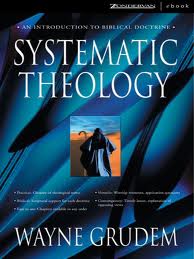
FREE Systematic Theology Class!

Monergism.com is offering a FREE systematic theology class courtesy of Dr. Wayne Grudem. I personally have used Grudem’s Systematic Theology text for all of my systematic theology classes as Southern Seminary. I believe it is one of the best at outlining all of the critical subject matter in a amazingly biblical and thorough way. If you get this free resource I would also recommend having the book as a reference to follow along. But hey, who can pass up free!?! (oh but wait, you do have to cover the cost of shipping…man, they always get ya.) Still though, this tiny cost is way cheaper than the thousands I spent for 9 hours of seminary credit!

Click HERE for the link to this free resource.

His book, Bible Doctrine, is a “CliffsNotes” version of his full systematic theology (though a pretty hefty book in its own right). It is great for the nonacademic setting. This is effective as a book study for those who want to go deep into the doctrines of the church.

Below is a description of the CDs.

********

Format: 3 Free MP3 CDs – These CDs will be mailed directly and we only ask that you cover the cost of shipping.

Availability: Due to High Demand, ships in 4-5 business days. Limit of one set of CDs per order.

Description: With the generous permission of Dr. Wayne Grudem, Monergism Books is giving away for free his complete class on systematic theology, a total of 119 class lectures.

The Christian church has a long tradition of systematic theology, that is, studying theology and doctrine organized around fairly standard categories such as the Word of God, redemption, and Jesus Christ. This introduction to systematic theology has several distinctive features:
– A strong emphasis on the scriptural basis for each doctrine and teaching
– Clarity, with technical terms kept to a minimum
– A contemporary approach, treating subjects of special interest to the church today
– A friendly tone, appealing to the emotions and the spirit as well as the intellect
– Frequent application to life

About the Speaker:
Wayne Grudem is Research Professor of Theology and Biblical Studies at Phoenix Seminary in Phoenix, Arizona. He holds degrees from Harvard (BA), Westminster Seminary (MDiv), and Cambridge (PhD). He is the author of over fifteen books including the bestselling Systematic Theology.

If I Were The Devil…

In 1942 C.S. Lewis published a classic in christian literature, The Screwtape Letters. I have read this book several times and enjoy it more with each reading. It is a satirical novel written in the form of letters from a senior demon, Screwtape, to his nephew, a junior “tempter” named Wormwood. Lewis enters the mind of the enemy and shows the devilish strategies behind the seemingly routine life of Wormwood’s “Patient”. Through the negative vantage point of a demon’s eyes, we see the unpacking of important life lessons. We see the unfolding temptations and trials of the “Patient” in new light and gain understanding into our own lives and the spiritual impact of every event.

Although The Screwtape Letters is one of C.S. Lewis’ most popular works, Lewis reveals in the final pages that it was not easy to bend his mind in such a way. He claims it was “not fun” to write, and “resolved never to write another ‘Letter’.” (p.184)

I am reminded of this masterful piece of christian literature because of its similarity to an audio piece recorded by the well remembered talk radio personality, Paul Harvey.  Mr. Harvey recorded the below clip in 1965. It amazes me that whether we are discussing Lewis, published in 1942, or Harvey, aired in 1965, the principles of Scripture aptly speak to us today. Both mediums take the negative perspective and show us a fresh understanding of our times. They prophetically call us to examine our lives and our society under the standard of God’s Word.

It is my prayer that you would listen to this 2:54 clip, maybe go out and read some C.S. Lewis, and polish the lenses of your Christian Worldview through which we best understand reality all around us.

Your fellow worker in the field,  Adam

Legalization of Same-Sex Marriage will Impact ALL of Us.

As we have all been aware of President Obama’s recent endorsement of legalizing same-sex marriage, we may not all be aware of the implications of such an action will have on all of us, even those who oppose it.  I’ve already read many versions of “if you don’t like it, then don’t do it”.

Psychologytoday.com posted this article defending gay marriage and ended with this quote:

From my perspective, it comes down to common sense. If it helps some people and it doesn’t hurt anyone, why not let in happen. I think the comedian Wanda Sykes put it best, “It’s real simple. If you don’t believe in same-sex marriage, don’t marry someone of the same sex.” In other words, why not allow gay marriage?

Why not?  There are many negative implications that must be considered!  Marriage is the foundational institution of our nation.  To redefine it changes the foundation and thus the trajectory we are headed as a nation.  Marriage was instituted first by God himself, before sin came into the world, and defined as one man and one woman. To redefine that is to reject God’s design and plan.

If same-sex marriage is legalized will it really effect you and me?  Yes.  We are seeing this already in Massachusetts, the first state to legalize same-sex marriage.

This clip shows how the public schools are teaching same-sex marriage as “normal and acceptable”.  I just registered my daughter for Kindergarten in our town literally last week.  It scares me to think she will be exposed to anti-biblical, morally bankrupt lifestyles as “normal and acceptable”.

From kindergarten to high school, our children will be exposed to “tolerance” and “equality” as a way to impose an unbiblical worldview into their developing value system.

Whenever you hear the counter argument stating that “studies show” same-sex marriages do not have a negative impact on a child’s development, be ready to think rationally and critically.  Do your research to find what “studies” have been done.  We all know statistics can be used in a bias manner to prove anything.

In his blog article Same Sex Marriage: Good for Gays, Bad for Children, Dennis Prager quotes on this topic:

As Professor Don Browning of the University of Chicago recently wrote in the New York Times, “We know next to nothing” about the effects of same-sex parenting on children.” “The body of sociological knowledge about same-sex parenting,” he and his co-author wrote, “is scant at best. … There are no rigorous, large-scale studies on the effect of same-sex marriage on the couples’ children.”

With a sample size as limited and reclusive as practicing same-sex couples with children, even a non-scientific mind as myself sees a flaw in reporting any results as authoritative. Beware what the “studies show”, because the studies are extremely limited at best and conducted with bias at worst.

So lastly, what should Christians do and think about these issues in our day?  It is good to remember that Jesus engaged His culture, not ignored it.  We should take an active role as this is developing.  We are blessed to be able to voice our opinions and vote accordingly. Start there.  Also we need to think rightly about these issues.  Here is a post a good friend of mine, Mark Moore, used to direct Christians to 5 good blog responses to the current debate.  Read over these and know where you stand. There is some valuable wisdom written down here.

We know God is in control and trust Him through the thick and the thin.  Be in prayer for our country and our leaders as we traverse difficult days.  Teach the truth, even when it is not politically correct.  2 Tim 3:12-14 says, “In fact, everyone who wants to live a godly life in Christ Jesus will be persecuted,  while evildoers and impostors will go from bad to worse, deceiving and being deceived. But as for you, continue in what you have learned and have become convinced of, because you know those from whom you learned it.”

Let us continue in what we have learned, because we know where we have learned it, namely the Word of God.

Your fellow worker in the field,  Adam

Leo Tolstoy: Youth Group President?

Check out this great article I came across via Trevin Wax.

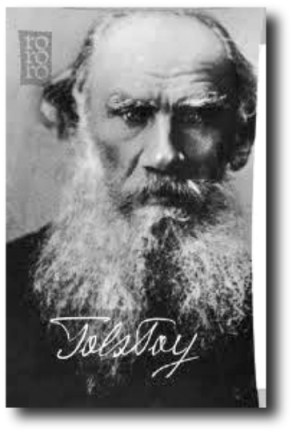
Leo Tolstoy, a russian philosopher, best known for his novel War and Peace, pursued (unsuccessfully) moralistic perfection in his faith. Is this what we are really teaching?  Do we teach the bible solely so we can be better people?  The Gospel is about much more than fixing our behavior!  The great misinterpretation of the christian faith, that Tolstoy also believed, is that we must try harder to be accepted by God!

“Children and students, indeed all of us, are incapable of living the Christian life in our own merit. We are utterly unable to transform ourselves. Because of this simple truth, transformation is not about trying; it is about dying. The apostle Paul knew that transformation occurs when we continually die to ourselves and trust the grace of Christ fully: “For we who live are always being given over to death for Jesus’ sake, so that the life of Jesus also may be manifested in our mortal flesh” (2 Cor. 4:11).”

I love that sentence. “Transformation is not about trying; it is about dying.”  Check out this article and see if you agree with the conclusions!

CNN posts about MTD

Crazy.  CNN has even picked up on the MTD (moralistic therapeutic deism) terminology when most people in our churches are unfamiliar with this phenomenon.  Check out the CNN article for yourself.

I will say this about the article. It clearly shows the infiltration of MTD into todays youth culture and contrasts that with  a “committed” faith.  So on that part I am thankful that even CNN recognizes the inadequacy of MTD as sincere faith.  Unfortunately this picture of the truly committed Christian does not include Jesus Christ.

No matter their background, Dean says committed Christian teens share four traits: They have a personal story about God they can share, a deep connection to a faith community, a sense of purpose and a sense of hope about their future.

In this article you will find a level playing field for varieties of “christian faith”, Catholic and Protestant.  I believe if you hone in on the evangelical, Gospel-centered denominations you will find more resistance to the infiltration of MTD.  Yet the problem is present in all faith traditions.  Even in the best churches you will find members, and particularly teenagers, who cannot speak accurately about the life, death, burial, and resurrection of Jesus, and what that means for us today.

“If teenagers lack an articulate faith, it may be because the faith we show them is too spineless to merit much in the way of conversation,” wrote Dean, a professor of youth and church culture at Princeton Theological Seminary.

Not only parents, but churches receive the brunt of blame for this weak understand of christianity among teenagers.

Churches, not just parents, share some of the blame for teens’ religious apathy as well, says Corrie, the Emory professor. She says pastors often preach a safe message that can bring in the largest number of congregants. The result: more people and yawning in the pews.

Read the article and see what you think.  It is from a secular perspective but has a fair treatment of MTD.  It is my prayer that more youth leaders and parents will understand the reasons teens drift toward this watered down version of the Gospel, and then fight against it!  We must teach and live the truthfulness of the whole counsel of God. We must understand it is not about us but about the Glory of God!

Your fellow worker in the field,  Adam

Cars, Faith, and Passing a Legacy

I love cars.  My granddad worked for Ford Company most of his life as a mechanic and salesman. We’ve been a Ford family ever since.  My dad would tell me stories of his 60s something Gran Tornio that he would burn the rubber off the tires in.  I remember dad teaching me how to change the oil in cars, fix little things here and there, and most importantly just spending time together.

The History of Modern America in 15 Cars – cool link to see the changes in our nation through the lens of the auto world. This link got me thinking about things I want to pass on.

I bought a motorcycle in college.  It was fun. I think I had it for a year or two. One day I saw an old Mustang sitting on the side of the road in a an out-of-the-way neighborhood.  I mustered up some courage to knock on the door and talked to a guy about his car. Goodbye motorcycle. I bought a 1973 Mustang coupe with a 351 Cleveland V8 engine. That was my senior year of college, before marriage, before kids, before responsibility.

I hope to pass this car on to my kids one day. (I think my 3 year old son thinks Mustangs are the coolest, fastest cars on the planet…despite mine being pretty junky in the grand scheme of things.)

My car sits in my garage and once in a while gets a little attention.  But its not about the adrenaline rush. Its more about the legacy.  I want to pass on something worthwhile to my kids.  Not just a physical thing either, but a mindset and sense of value.  I want them to think about thier great granddad fixing this same style car. I want them to remember our times together learning how to change oil and spark plugs.  Through building a car together I know I will also be building character into their lives.

In the same way, but infinitely more eternal way, we are to be passing down our faith to our families. God makes this passing of legacy a priority in His word.

Deuteronomy 6:4-9
Hear, O Israel: The LORD our God, the LORD is one. Love the LORD your God with all your heart and with all your soul and with all your strength. These commandments that I give you today are to be upon your hearts. Impress them on your children. Talk about them when you sit at home and when you walk along the road, when you lie down and when you get up. Tie them as symbols on your hands and bind them on your foreheads. Write them on the doorframes of your houses and on your gates.

2 Timothy 3:14-15
But as for you, continue in what you have learned and have become convinced of, because you know those from whom you learned it, and how from infancy you have known the holy Scriptures, which are able to make you wise for salvation through faith in Christ Jesus.

Proverbs 22:6
Train a child in the way he should go, and when he is old he will not turn from it.

Are you downloading your faith into the life of someone else?  Especially your children or the children whom you have influence? What values, habits, and beliefs are you passing on?  What is your legacy?  I know my legacy of faith will long outlast a car or any earthly thing.  Matthew 6:33 is a great reminder, “Seek first the Kingdom of God and His righteousness, and all these things will be added to you.”  Let our legacy be rooted in His Kingdom first!

Your fellow worker in the field,  Adam

Top 5 Things Introverts Dread about Church

Today is Sunday.  May the Lord Jesus be glorified in His bride today!  Even in how we treat one another.  We all are different and that diversity is one of the beautiful things about His Church.  I saw this article and thought about the many people for whom this is life, every week.  I hope I can be an encourager to all and respect the multitude of personality types present within my church today.  The original article is posted here.  Worth a read. 🙂

*********************************************************************

The Top 5 Things Introverts Dread about Church
(written so extroverts may understand)

5. “Welcome! Shake a hand, give a hug, share a name!”
In every church I have attended, this has been a precursor to the beginning of the service. What I want to know is why. There is no way that anyone is going to remember anyone else’s name in the 2.7 uncomfortable seconds it takes to say, “Good morning! My name is so-and-so. God’s peace.”

And has anyone considered what that is like for people who have never stepped foot in that church, or any church at all? I’ve been in church my entire life, and this entire process ties knots in my stomach. I understand the rationale behind it (we want to be a friendly, welcoming community), but isn’t this accomplished in a less forced manner before and after the service, over donuts and coffee?

Awkward encounters are so much easier with caffeine and sugar.

It is for this reason that I really love running slides or doing some other manner of work for the church during the beginning of the service. Can’t shake your sweaty hand if mine are busy doing something else.

4. “Chelsey, what do you think?”

Okay, look. I will tell you what I think once I want to say it. Trust me, I am very opinionated. Just because I am sitting quietly in this group of people, listening to all of them talk about their lives or this Bible passage or this idea, doesn’t mean I have a rock for a brain or that I’m too scared to speak up. Or, even worse: that something is wrong with me.

The worst offenders for this one are small group leaders and youth directors. And I know that for a fact, because I am one. Take it from me: if an introvert isn’t speaking, it isn’t because nothing is going on upstairs. It’s because they’re thinking. And once they feel comfortable enough, they will share. And yeah, that might take a couple minutes. A couple weeks. Maybe even a couple months. Their silence isn’t a reflection on your leadership! Leaders like me need to be secure enough in ourselves so that we can let the silence happen. It’s not “awkward” until you make it awkward.

3. “Let’s get into groups and pray aloud and/or tell each other our deepest, darkest struggles.”

At this point, you may be wondering if I actually like people. I like people. I really do.

Introverts tend to have deep relationships and friendships. They are often very few in number. Case in point: when planning our wedding, I told my husband Ted that I wanted three bridesmaids: my sister, my best friend, and his sister. He gave me his best puppy dog face and told me that he wouldn’t be able to go lower than 9 groomsmen. People just love Ted. I get it, obviously. (We ended up having 7 bridesmaids and 7 groomsmen, and I love and cherish every single one of them.)

At the church where I work, we meet weekly to pray over the prayer requests we receive as a staff. We separate into groups of 3 to 5, go to separate corners of the church, and begin to pray over the list. I have a mini-panic attack every single time. I hope I’m adept enough to cover it. I’m probably not.

2. Spontaneous Public Prayer

If you could see into my head while I pray aloud, it would look something like this:

“Dear Jesus: I am completely blanking right now. I know that when we usually talk, the conversation never ebbs, but all these people are looking at me and listening to me and I feel like I’m naked and I’m going to hyperventilate. If you love me – no, I know you love me – please give me something intelligent to say in front of all these people. That I work with every day. Who are expecting me to form a coherent sentence. If it’s fancy and a little theological, too, that would be great. Thanks a million. Amen.”

Recently, one of the pastors at my church gave a devotion about how people pray out loud. He said that if a person asks for things that God has already promised, like his presence or his faithfulness, then it’s foolish and they probably have a pretty weak faith.

Right. As if I wasn’t already self-conscious enough.

On Jon Acuff’s post about introverts, one very well-meaning woman tried to give an introvert some advice about praying out loud:

“Sometimes I have an apprehension of going to the bathroom in public with someone who is the in the stall right next to me. Sometimes it is really hard to avoid. However, I know I have to go, so what I do is close my eyes and just go with the flow. I would say the same to you the next time you are asked to pray out loud in front of others: Just close your eyes and go with the flow. He promises that as we open our mouths he will fill it with his words. I have found this to be true not only in my life, but also in the lives of others I know.”

I’m convinced that “go with the flow” is a distinctly extroverted phrase. Also, I’m not sure I’ll ever be able to use the phrase “go with the flow” again.

1. ”You should be more…”

Talkative. Friendly. Open. Or, my personal favorite: “You should be more like your sister.”

I once had a very influential camp counselor tell me that. My sister and I are very close now, and I would love to be more like her, because she is clearly cooler than I am.

When we were in high school, my sister was a beautiful, blonde, popular, fashionable, outgoing cheerleader. I was a somber, dark-haired band nerd who wore jeans and t-shirts and hated high school. Of COURSE I wanted to be more like her! Who wouldn’t?!

You would think that this sort of thing doesn’t happen to me anymore, but it does, actually. Even at 23, an age in which I am actually secure in my personality, this conversation takes place:

Me: “Yeah, I’m an introvert.”

The other person: “Oh, I’m so sorry.”

—–
God has created us all so beautifully and uniquely. There is no reason to apologize for that.

I am very sure that other introverts out there have had similar experiences. Please feel free to share, because I know that I shouldn’t be so presumptuous as to speak for all introverts everywhere.

But only if you feel comfortable enough.

Letter to an Incomplete, Insecure Teenager; by John Piper

This letter is a must read for anyone who has ever felt incomplete.  John Piper describes how he was not a “caterpillar” who disappeared into a cocoon only to emerge as beautiful butterflies when the time was right. But he (and all of us) are more like frogs who publicly transform from a tadpole to a frog with all the awkward stages in-between.

In this rare occasion that John Piper speaks to a teenager, we receive a skillful description of the process of sanctification and some real encouragement along the way. Check out the original article here. Read the whole thing, it’s worth it!

*************************************************************

Four years ago a teenager in our church wrote to me for advice about life in general, and identity in particular. Here is what I wrote, with a big dose of autobiography for illustration.

Dear ________,

My experience of coming out of an introverted, insecure, guilty, lustful, self-absorbed adolescent life was more like the emergence of a frog from a tadpole than a butterfly from a larva.

Larvae disappear into their cocoons and privately experience some inexplicable transformation with no one watching (it is probably quite messy in there) and then the cocoon comes off and everyone says oooo, ahhh, beautiful. It did not happen like that for me.

Frogs are born teeny-weeny, fish-like, slimy, back-water-dwellers. They are not on display at Sea World. They might be in some ritzy hotel’s swimming pool if the place has been abandoned for 20 years and there’s only a foot of green water in the deep end.

But little by little, because they are holy frogs by predestination and by spiritual DNA (new birth), they swim around in the green water and start to look more and more like frogs.

First, little feet come out on their side. Weird. At this stage nobody asks them to give a testimony at an Athletes in Action banquet.

Then a couple more legs. Then a humped back. The fish in the pond have already pulled back: “Hmmm,” they say, “this does not look like one of us any more.” A half-developed frog fits nowhere.

But God is good. He has his plan and it is not to make this metamorphosis easy. Just certain. There are a thousand lessons to be learned in the process. Nothing is wasted. Life is not on hold waiting for the great coming-out. That’s what larvae do in the cocoon. But frogs are public all the way though the foolishness of change.

I think the key for me was finding help in the Apostle Paul and C. S. Lewis and my father, all of whom seemed incredibly healthy, precisely because they were so absolutely amazed at everything but themselves.

They showed me that the highest mental health is not liking myself but being joyfully interested in everything but myself. They were the type of people who were so amazed that people had noses—not strange noses, just noses—that walking down any busy street was like a trip to the zoo. O yes, they themselves had noses, but they couldn’t see their own. And why would they want to? Look at all these noses they are free to look at! Amazing.

The capacity of these men for amazement was huge. I marveled and I prayed that I would stop wasting so much time and so much emotional energy thinking about myself. Yuk, I thought. What am I doing? Why should I care what people think about me. I am loved byGod Almighty and he is making a bona fide high-hopping frog out of me.

The most important text on my emergent frogishness became 2 Corinthians 3:18 —

And we all, with unveiled face, beholding the glory of the Lord, are being transformed into the same image from one degree of glory to another.

This was one of the greatest secrets I ever discovered: Beholding is becoming.

Introspection must give way to amazement at glory. When it does, becoming happens. If there is any key to maturity it is that. Behold your God in Jesus Christ. Then you will make progress from tadpole to frog. That was a great discovery.

Granted, (so I thought) I will never be able to speak in front of a group, since I am so nervous. And I may never be married, because I have too many pimples. Wheaton girls scare the bejeebies out of me. But God has me in his hand (Philippians 3:12) and he has a plan and it is good and there is a world, seen and unseen, out there to be known and to be amazed at—why would I ruin my life by thinking about myself so much?

Thank God for Paul and Lewis and my dad! It’s all so obvious now. Self is simply too small to satisfy the exploding longings of my heart. I wanted to taste and see something great and wonderful and beautiful and eternal.

It started with seeing nature and ended with seeing God. It started in literature, and ended in Romans and Psalms. It started with walks through the grass and woods and lagoons, and ended in walks through the high plains of theology. Not that nature and literature and grass and woods and lagoons disappeared, but they became more obviously copies and pointers.

The heavens are telling the glory of God. When you move from heavens to the glory of God, the heavens don’t cease to be glorious. But they are un-deified, when you discover what they are saying. They are pointing. “You make the going out of the morning and the evening to shout for joy” (Psalm 65:8).

What are the sunrise and sunset shouting about so happily? Their Maker! They are beckoning us to join them. But if I am grunting about the zit on my nose, I won’t even look out the window.

So my advice is: be patient with the way God has planned for you to become a very happy, belly-bumping frog. Don’t settle for being a tadpole or a weird half-frog. But don’t be surprised at the weirdness and slowness of the process either.

How did I become a preacher? How did I get married? God only knows. Incredible. So too will your emergence into what you will be at 34 be incredible. Just stay the course and look. Look, look. There is so much to see. The Bible is inexhaustible. Mainly look there. The other book of God, the unauthoritative one—nature—is also inexhaustible. Look. Look. Look. Beholding the glory of the Lord we are being changed.

I love you and believe God has great froggy things for you. Don’t worry about being only a high-hopping Christlike frog. Your joy comes from what you see.

Beloved, we are God’s children now, and what we will be has not yet appeared; but we know that when he appears we shall be like him, because we shall see him as he is.

There is another metamorphosis awaiting. It just gets better and better. God is infinite. So there will always be more of his glory for a finite mind to see. There will be no boredom in eternity.

Affectionately,

Pastor John