Confession of Faith within The Star Spangled Banner

Did you know The Star Spangled Banner has more than one verse? It has four in fact. If you read over these verses you will gain even more insight into the fabric of our nation.

Verse 1:

O say can you see by the dawn’s early light,
What so proudly we hailed at the twilight’s last gleaming,
Whose broad stripes and bright stars through the perilous fight,
O’er the ramparts we watched, were so gallantly streaming?
And the rockets’ red glare, the bombs bursting in air,
Gave proof through the night that our flag was still there;
O say does that star-spangled banner yet wave,
O’er the land of the free and the home of the brave?

Verse 4:

O thus be it ever, when freemen shall stand
Between their loved home and the war’s desolation.
Blest with vict’ry and peace, may the Heav’n rescued land
Praise the Power that hath made and preserved us a nation!
Then conquer we must, when our cause it is just,
And this be our motto: “In God is our trust.”
And the star-spangled banner in triumph shall wave
O’er the land of the free and the home of the brave!

While I will in no way will make the argument that our nation is a Christian nation, for those of you like myself who want to see this generation come to know the hope and purpose found only through the Gospel of Jesus Christ, it is helpful to refer back to markers of Christian heritage in our country. Within the national song is a clear confession of faith. Note the reference, unashamedly, to praising the “Power” (note the capitalization indicating a person) that makes and preserves nations. Wow. And what a motto; “In God is our trust”. If only more individuals would have such a motto in their own lives.

As we celebrate our freedom on this fourth of July, would you recognize that Jesus offers a freedom that will last for eternity. Romans 8:2 says, “For the law of the Spirit of life has set you free in Christ Jesus from the law of sin and death.” Nations will rise and fall, but freedom in Christ is TRUE freedom. John 8:36 says, “So if the Son sets you free, you will be free indeed.”

Find your freedom in Him today.

Your fellow worker in the field, Adam

Are You Having Conversations That Really Matter?

What kind of conversations are the most common between adults and children? Here is a graphic that shows the types of questions asked at what ages. Interesting. As a father of young children and a full time youth worker, I simultaneously see both ends of the spectrum. I’d say in an over-generalized kind of way, it is pretty much right on.

Do you notice any blaring deficiencies? Where are the questions about God? Where are the conversations about faith? Where are the opportunities to really know why you believe what you you believe?

I am reminded of Deuteronomy 6:4-9. This is the Sh’ma (or Shema). It is the most important prayer in the Jewish faith, past and present. The word “Sh’ma” is the hebrew word for “hear” which is the opening call to action in the text.

“Hear, O Israel: The Lord our God, the Lord is one.[b]You shall love the Lord your God with all your heart and with all your soul and with all your might. And these words that I command you today shall be on your heart.  You shall teach them diligently to your children, and shall talk of them when you sit in your house, and when you walk by the way, and when you lie down, and when you rise.  You shall bind them as a sign on your hand, and they shall be as frontlets between your eyes. You shall write them on the doorposts of your house and on your gates.

Notice the intentionality to be used when talking to our children about God, faith, and matters of first importance. This text is a vivid reminder that we should be taking advantage of every opportunity that presents itself to initiate conversations about God.

We should do this at home. This is where our kids see the “real” us. It is where our guard is down. When we are simply ourselves. Does it show in those moments, though our speech, that God is the most important thing in our lives?

We should do this when we “walk by the way”. Ok, we don’t walk much anymore. But one great time for quality conversations is what I call, “windshield time”. You can really get a teenager to open up when you are driving and both staring out the windshield. Don’t be afraid to ask some probing questions now and then. In the car you have a captive audience…but remember, its equally about listening as it is talking.

We should do this when we “lie down and when we rise”. Let it be the last thing on your lips at night and the first thing on your lips in the morning. What is “it” you say: the Glory of God and the awesomeness of Jesus Christ! Say bedtime prayers together. Small habits like that have big influences on kids. On the morning side, a memory that will forever be burned in my mind is dragging myself out of bed everyday as a rebellious teenager only to see my mom reading her bible at the breakfast table. She never force that on me, but her example spoke volumes. Now as an adult, looking back on those years I thank God for her faithfulness and see its influence in my own life.

So what kind of conversations are we initiating with the children in our lives? Both our biological children and any of those whom we have influence over. Maybe you are a small group leader, a soccer coach, the minivan mom who gives rides to every kid in the neighborhood. How are you using your words to push the next generation closer to an authentic relationship with the God of the universe? I pray you will “hear” the call to do just that!

Your fellow worker in the field, Adam

Saturdays with C.S. Lewis: Liar, Lunatic, or Lord?

C.S. Lewis has a way with words that cut to the heart. He speaks plainly, but powerfully. In a concise bit of logic Lewis reminds us that the claims of Christ leave very limited options for us in our response. Who do you say Jesus is? Does that correspond to who He said he was? While this argument has been retold many times since Lewis set the stage, read his words anew and allow them to challenge you.

“I am trying here to prevent anyone saying the really foolish thing that people often say about Him: I’m ready to accept Jesus as a great moral teacher, but I don’t accept his claim to be God. That is the one thing we must not say. A man who was merely a man and said the sort of things Jesus said would not be a great moral teacher. He would either be a lunatic — on the level with the man who says he is a poached egg — or else he would be the Devil of Hell. You must make your choice. Either this man was, and is, the Son of God, or else a madman or something worse. You can shut him up for a fool, you can spit at him and kill him as a demon or you can fall at his feet and call him Lord and God, but let us not come with any patronizing nonsense about his being a great human teacher. He has not left that open to us. He did not intend to.”

Your fellow worker in the field, Adam


What Do Christian Teenagers Believe about Jesus?

Biola Magazine has done some research and produced this thought provoking article on the nuts and bolts behind the faith of the current generation of teenagers. We need to get specific about Jesus Christ and faithfully teach what the bible reveals. This generation is floundering in a vague divinity and spineless teaching when all along a strong clear picture of Jesus is on display in the pages of scripture. WIll we believe it? WIll we pass this on. Check out the below article and gain insight into the faith of this generation of teenagers.

Your fellow worker in the field, Adam

*******************************************

What does the faith of the next generation of Christians look like? When we examine the actual beliefs of Christian teenagers regarding Jesus and his meaning for our lives, is what we find encouraging or alarming?

In The Jesus Survey (Baker Books, 2012), bestselling author Mike Nappa (’89) explores these questions by presenting the results of a nationwide survey of Christian teens. Here, Nappa discusses some of his findings with Biola Magazine and talks about the takeaways for parents, teachers, youth pastors and anyone invested in the faith of future generations.

Mike, could you briefly describe the types of Christian teens that you surveyed and the survey methodology?

The Jesus Survey was administered during summer 2010 at Reach Workcamp mission sites in Colorado, Indiana, Maine, New York, Ohio, Texas, Virginia and West Virginia. (You can download a reproducible copy of the actual survey used at nappaland.com/tjs.) More than 800 teens, ages 12 to 18, participated in the survey. All teens self-identified as “Christian” and were active in a church youth group at the time of the survey. In all, the survey sample represented 16 Christian denominations from 24 United States, and delivered a 99 percent confidence level with a margin of error of +/- 4.4 percent.

What was the overall goal with “The Jesus Survey”? What did you want to find out?

The original goal was just to satisfy my own curiosity! I wanted to discover what Christian teens believed about Jesus — and how that was (or wasn’t) affecting their everyday lives. So I asked them.

In terms of the specific survey, the first part was designed to measure what teens thought about four core doctrines of Christ: 1) The Bible is completely trustworthy in what it says about Jesus. 2) Jesus is God. 3) Jesus physically lived, died and came back to life. 4) Jesus is the only way to heaven.

Having established those baselines, the second part of the survey was designed to measure how a Christian teen’s belief or unbelief in those core doctrines affected his or her daily experience with God.

While 86 percent of those surveyed reported that they viewed the Bible as at least somewhat trustworthy, 70 percent expressed persistent, measurable doubts that what the Bible says about Jesus is true. And these are “cream of the crop” youth group kids. How do we make sense of this, and should we be alarmed?

As a former youth pastor, those numbers do concern me. Realistically, just about everything our youth group teens know about Jesus came from what’s found in the Bible, so if they don’t trust the Bible, they can’t fully trust their own knowledge of Jesus. It seems to me that we parents and church leaders can do a better job of helping our Christian teenagers grow confident in the trustworthiness of Scripture.

What’s more (and this surprised me), the data show that Christian kids who do have strong confidence in Scripture actually experience God more noticeably in their daily lives. For instance, four out of five (82 percent) teens who have “unshakable” faith in the Bible also report possessing “strong” proof that the Holy Spirit is active in their lives. Among kids who are uncertain about Scripture, that number is less than half (49 percent). For Christian teens who disbelieve the Bible’s reliability, only 22 percent (about 1 in 5) strongly claim real-life experience with Christ’s Holy Spirit.

Christ’s exclusivity seems to be a big stumbling block for many teens. Fully 1 out of 3 (33 percent) of the Christian teenagers you surveyed believes that Jesus, Mohammad, Buddha and other great religious leaders all lead to heaven. Why do you think this is, and what are the implications?

What’s hard about this finding is that these are Christian kids — teens who claim to have already trusted in Jesus for heaven (and more). In spite of that, they seem unaware that their answers to this question actually contradict their own Christianity — and the beliefs of other religions, too. Youth culture researcher Christian Smith calls this a “tolerance over truth” attitude that’s a result of mainstream, social indoctrination. There’s probably some validity to Smith’s opinion, but it’s always easy to blame the world outside for problems inside the church.

Realistically, an enormous error in basic Christian truth like this one wouldn’t be widespread in our youth groups if adult Christians in our churches weren’t also embracing — and promoting — the fallacy. Tolerance and truth are not mutually exclusive — we need to be better at communicating both for our teens.

What’s worth noting here is that belief in the trustworthiness of the Bible is directly related to belief that Jesus, alone, saves. Among “Jesus only” kids, 99 percent also agreed with the statement that “The Bible is 100 percent accurate.” The implication there is both encouraging — and obvious.

Barely 5 percent of those surveyed reported that they study the Bible on a daily basis, with 67 percent reporting that they seldom or never study Scripture outside church, numbers that reflect a downward trend in Bible study from similar studies conducted 10 years ago. How do you think we can reverse this trend and get young people excited about the Bible?

Our first priority must be to help our Christian teenagers grow confident in the trustworthiness of Scripture. After all, why bother studying the Bible if its message can’t be trusted? If you can’t believe the Bible, then whatever it says is irrelevant. On the other hand, if the Bible can be trusted, then the Bible will be read — that’s my opinion.

I don’t see Scripture needing any special ad campaign or “teen friendly” package. It already has within its pages everything a Christian teenager wants and needs in life. What our kids must come to know is that their Bible is real and true and trustworthy. When they come to grips with that, it’ll change everything — and create a hunger for God’s Word that won’t be denied.

In the evangelism area, 84 percent said they believe Christians are “expected to tell others about Jesus,” while 56 percent said they actually did in the last month. Still, 56 percent seems pretty high. Are teenage Christians less afraid of evangelism than we think?

This was another of the surprises of The Jesus Survey: Christian teenagers are actually quite open and unashamed about their religion. What’s more, talking about Jesus to their friends seems to come naturally for this generation. Even among Christian teenagers who say that Jesus is not the only way to heaven, more than half (55 percent) believe that every follower of Christ has a responsibility to tell others about Jesus “with the intent of leading them to be Christian too.” This unexpected openness about faith may be a benefit of that “tolerance indoctrination” our kids are experiencing in their society. After all, if all religions are tolerated, then it’s OK to talk about any religion — even when the topic is Jesus.

At the same time, there is cause for concern about the evangelistic passion of our Christian teenagers. If the things they’re saying about Christ reflect what they actually believe about Christ, then (according to The Jesus Survey at least), three-fourths of them (74 percent) are actually spreading untruth about Jesus to their friends, neighbors, coworkers and more.

What encouraged you most from the results of the survey?

I was humbled and grateful to see, right there in the data, that God rewards teenagers who place full faith in him. Or, as I put it in the book, “Right belief translates into real experience.”

As part of the study, I was able to identify what I called “Confident Christian Teens.” This group of kids consistently and strongly affirmed each of the four core beliefs around which the survey centered. These kids were the minority in their youth groups (outnumbered 10 to 1 actually), but they reported a real-life experience with God that was identifiable and ongoing.

For example, 94 percent of Confident Christian Teens strongly agreed with this statement: “I’m 100% certain Jesus has answered one or more of my prayers—and I can prove it.” Among the rest, only about half (55 percent) could say the same thing. Additionally, nearly nine out of 10 (86 percent) Confident Christian Teens strongly agreed with this: “I’m 100% certain that the Holy Spirit of Jesus is present and active in my life today — and I have proof that this is true.” Among all other Christian teens, barely half (52 percent) could make the same claim.

For parents, youth group leaders, pastors, professors and others who care about the beliefs of the next generation, what are the big takeaways from this data?

The absolute best thing you can do for any Christian teenager is to help that teen grow confident in the trustworthiness of Scripture. Teens who believe the Bible is reliable are more likely to embrace authentic Christian beliefs and — according to the data — are significantly more likely to experience an authentic, noticeable relationship with God. That’s the big takeaway I learned from The Jesus Survey.

If you could summarize your overall assessment of the current generation of Christian teenagers in just three words, what would they be?

Honest. Tolerant. Passionate.


Mike Nappa (’89) is a bestselling and award-winning author with more than 1 million copies of his books in print worldwide. He’s also the founding publisher of FamilyFans.com, “The Free E-Magazine for Parents” and a noted commentator on pop culture, theology, family and film.

6 Myths of Success

In ministry it is easy to get hung up on the wrong things. As humans we are bent in our nature to
misunderstand the things of God and chase after lesser things. Pastors are tempted to rate success by the criteria of this world rather than from our God. When applied to student ministry this reminds me of my article, True Success in Student Ministry. Here are 6 myths that can creep into a pastor’s mind according to Scott Thomas of the Acts 29 Network.

  1. “Success is a result of my great faith.” God makes his sun rise on the evil and on the good, and sends rain on the just and on the unjust (Matthew 5:45). He is sovereign.
  2. “Success comes after hard work.” Paul warned to put no confidence in the flesh, and whatever redeeming merit Paul experienced, he counted it as trash (Phil. 3:2–11).
  3. “Success brings me love.” Success, or the lack of success, is a false indicator of God’s love for me (Job 10:12–13).
  4. “Success proves my level of spirituality.” Your spirituality is not validated by your success or evident because of it. Our spiritual life is only because of Jesus Christ’s completed work (Rom. 3:21–28).
  5. “Success makes me happy.” Success can never be satisfied; it always craves more (Eccles. 5:10).
  6. “Success is achieved through strength.” God intentionally chooses the unlikely so that all success can be ascribed to God. (1 Cor. 1:26–31). God’s grace is illuminated in weakness (2 Cor. 12:9).

Your fellow worker in the field,  Adam

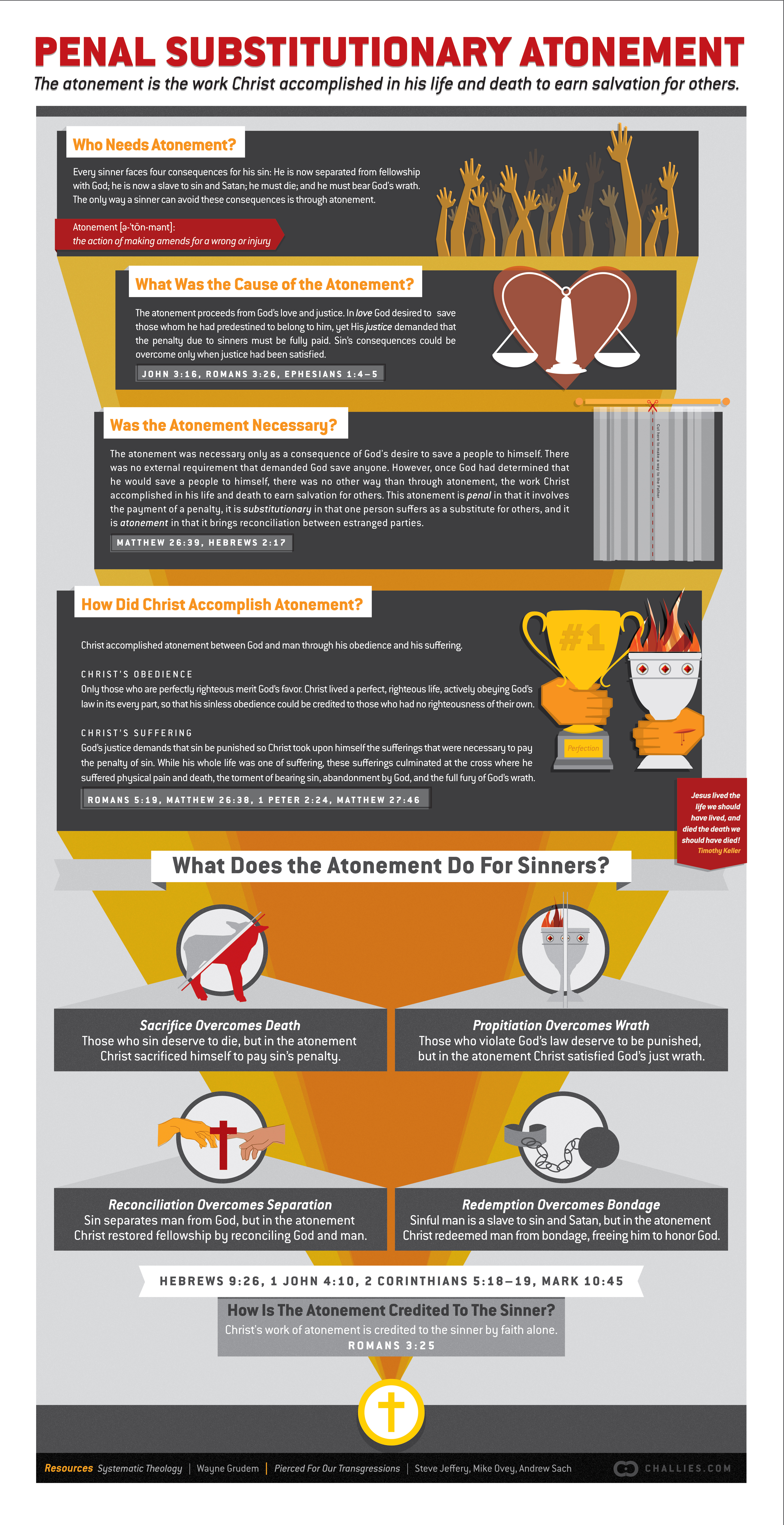
NEW Visual Theology Info-graphic: The Atonement

Check out Tim Challies’ NEW info-graphic: The Atonement. To see all of his info-graphics click on the Visual Theology tab in the above menu bar. Aren’t these things great!? They draw you in visually but speak volumes of information on hard to understand topics! I love ’em.

5 Ways to Make Your Kids Hate Church

I’ve been working with teenagers for a long time. It is easy to spot the ones who want to attend church or small group, and the ones who couldn’t care less about being there. More times than not kids adopt the attitudes and practices of their parents. Children are very observant and can discern even the slightest hint of superficiality. Here are 5 ways to make your kids hate church.

1. MAKE SURE YOUR FAITH IS ONLY SOMETHING YOU LIVE OUT IN PUBLIC

Go to church… at least most of the time. Make sure you agree with what you hear the preacher say, and affirm on the way home what was said especially when it has to do with your kids obeying, but let it stop there. Don’t read your Bible at home. The pastor will say everything you need to hear on Sundays. Don’t engage your children in questions they have concerning Jesus and God. Live like you want to live during the week so that your kids can see that duplicity is ok.

2. PRAY ONLY IN FRONT OF PEOPLE

 The only times you need to pray are when your family is over, holiday meals, when someone is sick, and when you want something. Besides that, don’t bother. Your kids will see you pray when other people are watching, no need to do it with them in private.

3. FOCUS ON YOUR MORALS

Make sure you insist your kids be honest with you. Let them know it is the right thing for them to do, but then feel free to lie in your own life and disregard the need to tell them and others the truth. Get very angry with your children when they say words that are “naughty” and “bad,” but post, read, watch, and say whatever you want on TV, Facebook, and Twitter. Make sure you focus on being a good person. Be ambiguous about what this means.

4. GIVE FINANCIALLY AS LONG AS IT DOESN’T IMPEDE YOUR NEEDS

Make a big deal out of giving at church. Stress to your children the value of tithing, while not giving sacrificially yourself. Allow them to see you spend a ton of money on what you want, while negating your command from Scripture to give sacrificially.

5. MAKE CHURCH COMMUNITY A PRIORITY… AS LONG AS THERE IS NOTHING ELSE YOU WANT TO DO

Hey, you are a church-going family, right? I mean, that’s what you tell your friends and family anyways. Make sure you attend on Sundays. As long as you didn’t stay up too late Saturday night. Or your family isn’t having a big barbeque. Or the big game isn’t on. Or this week you just don’t feel like it. Or… I mean, you’re a church-going family, so what’s the big deal?

This article was originally posted at the theResurgence.com by Thomas Weaver. Check it out for a lot of good writing on many different topics.

Your fellow worker in the field,  Adam

This is the Truth

Sometimes we get so upside down in life. Keep your focus on Jesus today!

Your fellow worker in the field, Adam

Get Your Free Copy of Pilgrim’s Progress

I’ve done a few blog posts making reference to John Bunyan’s classic work, Pilgrim’s Progress. If you have never read it, but wanted to, below is a link to the FREE e-book copy through Amazon. Hard to pass up free!

Did you know this book has been translated into 200+ languages. It was written in 1678 and has NEVER been out of print.

Click Here. Kindle Deal of the Day: The Pilgrim’s Progress by John Bunyan.

“Next to the Bible, the book I value most is John Bunyan’s The Pilgrim’s Progress.” –Charles Spurgeon

10 NEEDED Reminders for Dating Couples Before Marriage

1. It’s not bad to want to have sex with your significant other. It’d be another sort of worry if you didn’t. The key is to want to glorify Christ more than you want to have sex with each other.

2. The key to glorifying Christ more than you want to have sex with each other is that it is a decision to be made over and over again.

3. Persons in a dating or courting relationship are on their best behavior. So however they are now, you can expect, over time, for them to get “worse.” As familiarity grows, people let their guards down. Marriage does not fix bad behavior; it often gives it freer reign. Ladies, this means if your boyfriend is controlling, suspicious, verbally condescending or manipulative, he will get worse, not better the longer your relationship goes on. Whatever you are making excuses for or overlooking now, will get harder to ignore and more prominent the longer your relationship goes on. You can’t fix him, and marriage won’t straighten him out.

4. Nearly every Christian I know who is married to an unbeliever loves their spouse and does not necessarily regret marrying them, but has experienced deep pain and discontent in their marriage because of this unequal yoking and would now never advise a believer to marry an unbeliever.

5. Assuming you’re special and you’re different and their experiences won’t reflect yours is shortsighted, unwise, and arrogant. The people who love you and are warning/advising you against your relationship might be ignorant fools. Those sorts of people do exist. But odds are better that your parents, your pastor, your older married friends are wiser than you think.

6. Living together before marriage is a marriage killer.

7. Premarital sex de-incentivizes a young man to grow up, take responsibility, and lead his home and family.

8. Pre-marital sex wounds a young woman’s heart, perhaps imperceptibly at first but undeniably over time, as she trades in covenant benefits without covenant security. This is not the way God designed sex to fulfill us. Never give your body to a man who has not pledged to God his faithfulness to you in covenant marriage, which presupposes an accountability to a local church. In short, don’t give your heart to a man who is not accountable to anybody who provides godly discipline.

9. All of your relationships, including your romantic relationship, is meant to make Jesus look big more than it is meant to provide you personal fulfillment. When we make personal fulfillment our ultimate priority in our relationships, ironically enough, we find ourselves frustratingly unfulfilled.

10. You are loved by God with abundant grace in Christ’s atoning work, and an embrace of this love by faith in Jesus provides Holy Spiritual power and satisfaction to pursue relationships that honor God and thereby maximize your joy.


This awesome article was written by Jarred Wilson and published through The Gospel Coalition at This Link. I pray it help you think biblically about your dating relationships leading to a godly marriage.

Your fellow worker in the field,  Adam